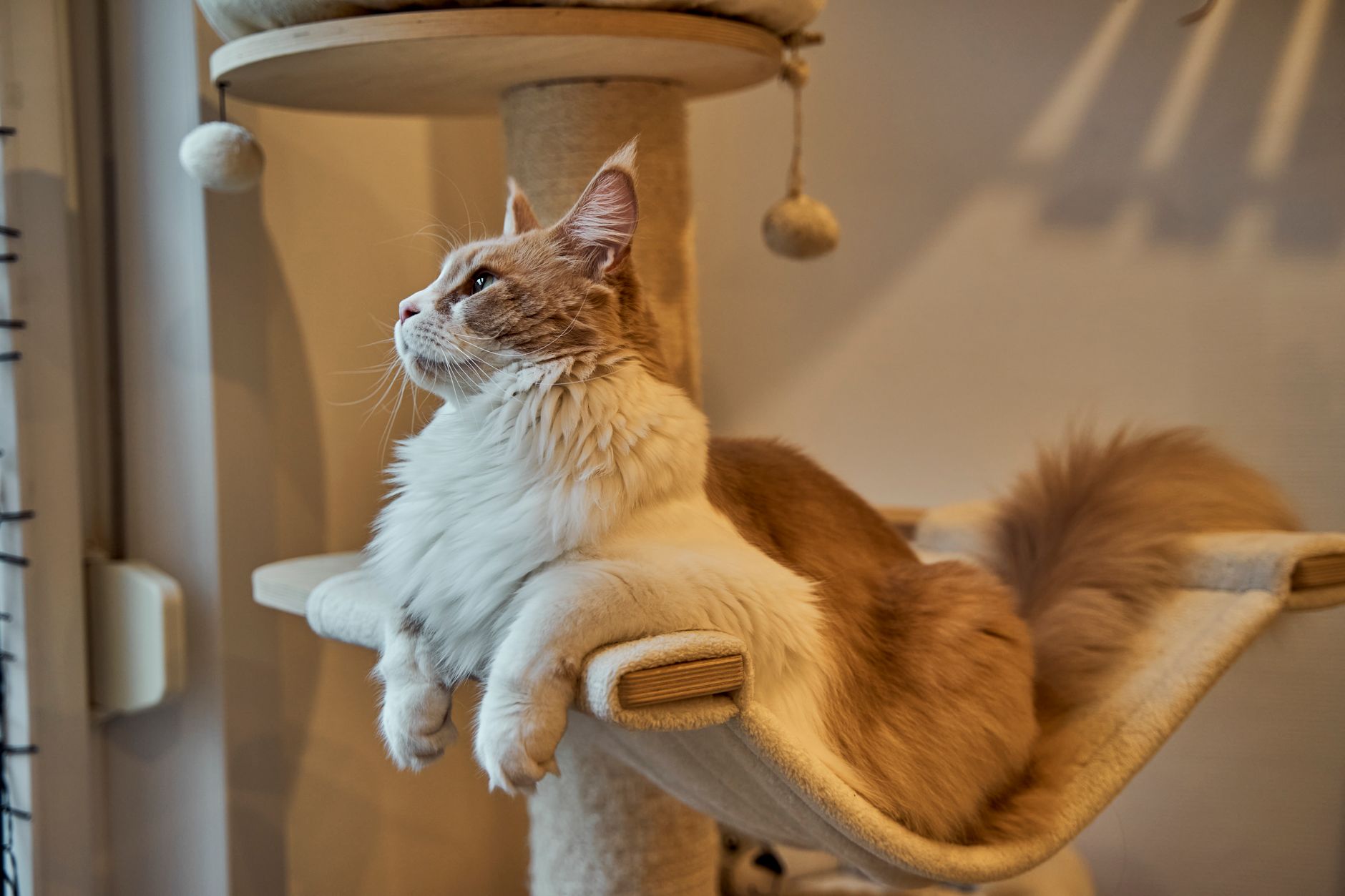
No published research shows Maine Coons get zoomies more often than other breeds. The breed does not appear at either extreme of the activity-level rankings in the largest owner surveys of cat behaviour, so a Maine Coon's sudden sprint down the hallway is a normal cat behaviour, not a breed trait. What makes Maine Coon zoomies memorable is size and development, not frequency. A 15-pound cat moving at speed is loud and dramatic, and the breed matures slowly enough that kitten-style play bouts continue in a cat that already looks fully grown.
Table of Contents
- What a zoomie actually is
- Does the breed evidence single out the Maine Coon?
- Why owners are convinced otherwise
- When zoomies happen, and what they are telling you
- The change that should send you to a vet
- Frequently Asked Questions
What a zoomie actually is
Veterinary behaviorists call the behaviour a frenetic random activity period, or FRAP: a short burst of running, pouncing or climbing that erupts without warning and ends within a few minutes. PetMD's veterinary-reviewed overview describes these bouts as normal and usually harmless, and notes there is no definitive research explaining why cats do it at all. Zoomies are not the same as play, and the difference is useful when you are judging your own cat.
Elizabeth Stelow, DVM, DACVB, chief of the behavior service at UC Davis, told PetMD that "zoomies appear almost out of control, whereas play is often more measured," and that unlike play they usually involve no interaction with a person or another animal. That distinction explains why the behaviour feels alarming. A cat engaged in play watches you, pauses, and resets. A cat in a FRAP is running a loop that has nothing to do with you.
Does the breed evidence single out the Maine Coon?
No study has measured FRAPs by breed. The closest available evidence is activity level, and the largest data set comes from a University of Helsinki group whose 2019 paper in *Scientific Reports* surveyed owners of 5,726 cats across 19 breeds and groups. Breed differences showed up in ten behaviour traits, and activity level had the strongest breed association in their models. The rankings are where the Maine Coon question gets answered. The most active breeds in that paper were the Cornish Rex, Korat and Bengal; the least active were the British Shorthair, Ragdoll and Sacred Birman.
The Maine Coon sits in neither list. The same group's 2021 follow-up in *Animals*, covering 4,316 cats and 26 breed groups, again put the Bengal at the top for activity and playfulness and the Persian and Exotic at the bottom, with no finding singling out the Maine Coon. Breed does shape activity to some degree. The 2019 study estimated heritability for seven traits, activity level among them, at 0.40 to 0.53, using Ragdoll, Maine Coon and Turkish Van pedigrees. So a Maine Coon's energy is partly inherited rather than purely a product of its household — it just is not inherited at an unusual level.
Why owners are convinced otherwise
Breed registries describe the Maine Coon as slow-maturing. The CFA puts full development at roughly three to four years and TICA at three to five, as reported by The Galveston County Daily News in its guide to the breed. That is the likeliest basis for owners reporting kitten-like bouts in a cat the size of a small dog. Age is also the clearest driver clinicians actually cite.
PetMD notes that adolescent and young cats carry more excess energy and zoom more often than adults. A Maine Coon spends an unusually long stretch of its life in that adolescent window, so the owner of a three-year-old Maine Coon and the owner of a three-year-old Russian Blue are not describing cats at the same developmental stage. Then there is the plain physics of it. All the breed-behaviour data above is owner questionnaire self-report rather than direct observation, which means perception is baked in. A 15-to-18-pound cat thundering across a floor registers as more zoomies than a six-pound cat doing the same thing.
When zoomies happen, and what they are telling you
The most common explanation is accumulated energy after a long rest. VCA Animal Hospitals notes that cats who nap through the day "often have pent-up energy—just in time for nightfall," which is why bouts cluster predictably: If your Maine Coon's zoomies are concentrated in those windows, you are looking at an energy-budget issue rather than a behaviour problem.
Two or three interactive play sessions spread through the day, with the longest one before your own bedtime, moves the discharge to a time you choose. Climbing matters more for this breed than for most. A large cat that wants to run vertically will use furniture if nothing sturdier exists, so cat trees and shelves rated for the weight are a practical fix rather than an indulgence.
- On waking from a long sleep
- Immediately after using the litter box
- In the evening and overnight
- After a stretch of being left alone
The change that should send you to a vet
Frequency is not the warning sign. Change is. New, constant or frantic zooming — particularly in a middle-aged or senior cat that never did it before — warrants a veterinary visit, because Cats.com's veterinary-reviewed guide notes FRAPs can signal hyperthyroidism, an overactive thyroid gland that floods the body with hormone.
Watch for the cluster, not the single symptom: A thyroid panel is a routine blood test, and the condition is treatable. The cat that has sprinted the same 10 p.m. circuit since kittenhood is a different animal from the eleven-year-old that started last month.
- A cat that previously did not zoom suddenly doing it often
- Weight loss despite a normal or larger appetite
- Restlessness that does not resolve after a few minutes
- Zoomies in a cat past middle age
Frequently Asked Questions
At what age do Maine Coon zoomies usually settle down?
Expect the kitten-style bouts to taper as the cat finishes developing, which registries put at about three to four years (CFA) or three to five (TICA) — later than most breeds.
Which breeds are documented as the most active?
In the 2019 Helsinki survey of 5,726 cats, the Cornish Rex, Korat and Bengal ranked highest for activity; the British Shorthair, Ragdoll and Sacred Birman ranked lowest.
Should I interrupt a zoomie in progress?
No. The bout is normal and typically over in a few minutes, and a cat in a FRAP is not engaging with you anyway — clear breakable objects from the route instead.