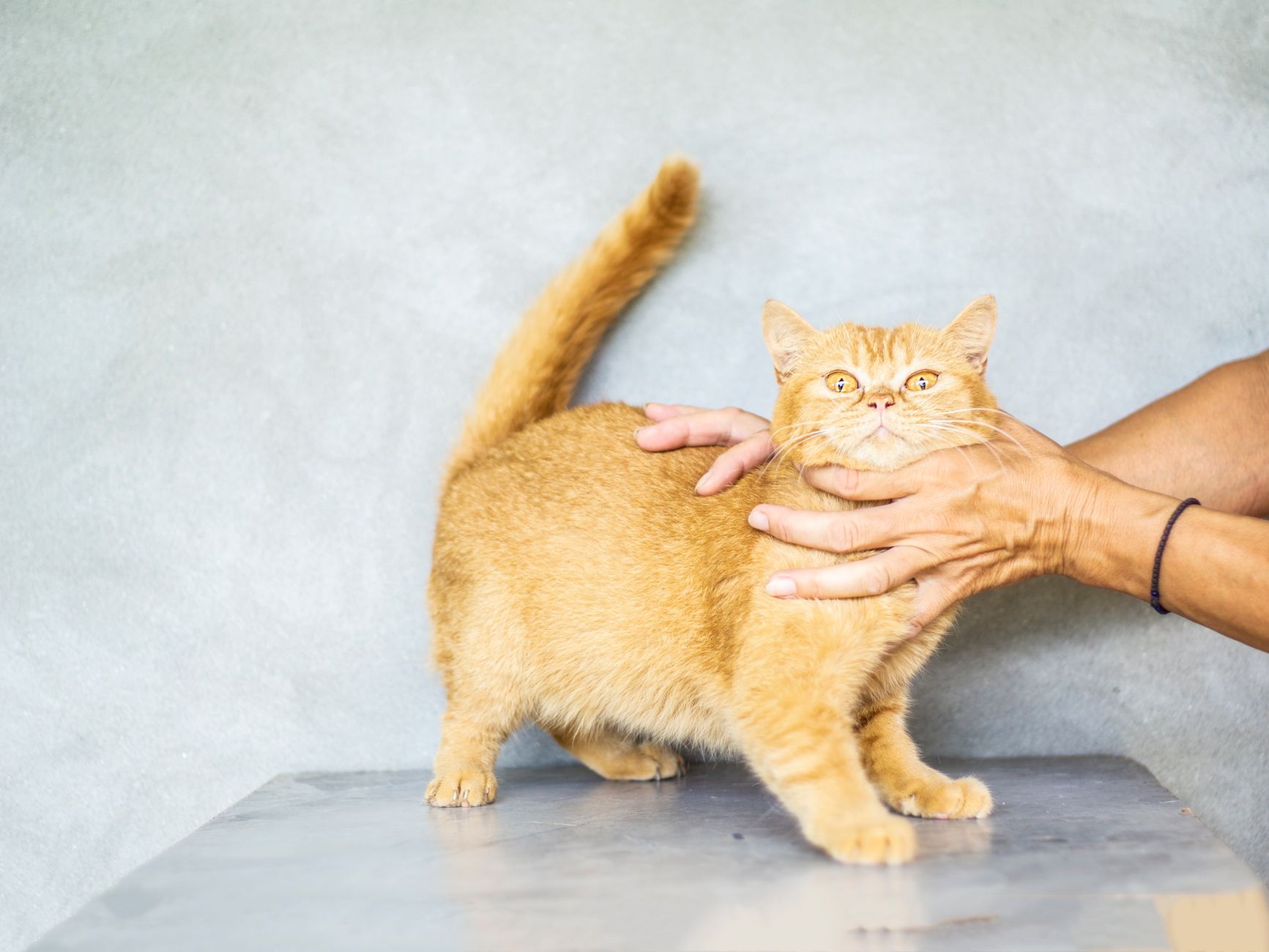
Cat anxiety shows up as a cluster of body-language and routine changes: a tense, crouched posture, ears rotated sideways or back, dilated pupils, hiding, and a tail held tight against the body. Over longer periods it looks less dramatic — a cat that eats less, grooms less, skips the litter box, plays less, and sleeps more than it used to.
The hardest part is that anxiety has no single tell. What matters is the shift away from how that particular cat normally behaves, and whether a medical problem is driving the behavior instead. Several of the classic "anxiety signs" — overgrooming, straining to urinate, sudden aggression — turn out to be physical illness more often than owners expect.
Table of Contents
- Acute fear: what a frightened cat looks like in the moment
- Chronic anxiety looks like a change in routine
- Litter box problems are the most common presenting sign
- The symptoms most often mistaken for anxiety
- When to call the vet, and what helps in the meantime
- Frequently Asked Questions
Acute fear: what a frightened cat looks like in the moment
Sudden fear usually makes a cat smaller, not louder. International Cat Care describes the acute stress signs as freezing, shaking, a tense crouched body, rapid breathing, and a tail tucked in close — the cat shuts down and tries to disappear rather than lashing out. The face changes before the body does. In its guidance for veterinary teams on feline protective emotions, International Cat Care lists ears rotated to the side or flattened back, pupils partially or fully dilated, rapid blinking, hard staring, and excessive lip-licking as the signals clinic staff are trained to read.
Lip-licking with no food present is a particularly easy one to miss at home. Escalation comes when the cat sees no way out. VCA Animal Hospitals describes the next stage as a puffed-up tail (piloerection), an arched back, hissing, and swatting or biting — most likely when the cat has been cornered — along with drooling and involuntary passing of urine or feces. A cat that reaches this point is not being aggressive by temperament; it has run out of options.
Chronic anxiety looks like a change in routine
Long-term stress rarely produces a scene. International Cat Care's summary of chronic stress points to quieter changes: not eating, or overeating; not grooming; not using the litter tray normally; resting more, or lying with eyes closed while clearly not asleep; hiding; and playing less than before. That list is only useful against a baseline.
A cat that has always slept fourteen hours and kept to one corner of the house may be perfectly content, while a formerly sociable cat doing the same thing has changed. Knowing your own cat's normal eating times, grooming habits, favorite spots, and sociability is what turns a vague worry into something a vet can act on. Signs worth writing down before a vet visit:.
- When the change started, and what else changed in the household around then
- Appetite: portions left, speed of eating, interest in treats
- Litter box: frequency, location, straining, posture, any blood
- Grooming: bald patches, scabs, over-licking one spot
- Hiding: where, how long, and whether the cat comes out for food
Litter box problems are the most common presenting sign
If anxiety has one headline symptom, it is elimination outside the box. The Feline Behavior Guidelines from the American Association of Feline Practitioners identify inappropriate elimination as the number-one behavior problem reported in cats, which makes litter box breakdown the single most common way feline distress reaches a veterinarian. The response matters as much as the recognition. Cornell University's Feline Health Center warns that punishing a house-soiling cat adds anxiety and can make the soiling worse, and that cats return to places they have already marked. The practical conclusion is to clean the spot thoroughly rather than correct the cat — the odor cue, not disobedience, is what brings it back.
Urinary signs can run deeper than placement. A 2025 study of 33 cats at the Vaudois university veterinary hospital, reported in the *Journal of Veterinary Behavior*, found that cats which internalize stress — nervous, withdrawn types — had more recurrent idiopathic cystitis than cats that externalize it through aggression. The sample is small and the study used no standardized behavioral tool, so treat it as a reason to mention temperament to your vet, not a diagnosis. The physiology is better established than that single study suggests. Work by Westropp and Buffington in the *American Journal of Veterinary Research* compared 13 cats with idiopathic cystitis against 12 healthy cats and found bladder permeability altered most during initial stress, while urine cortisol-to-creatinine ratios did not change — a sympathetic nervous response running separately from the usual stress-hormone axis. Straining, frequent small urinations, or blood in the urine always warrant a same-day call, since urinary blockage in male cats is a fast emergency.
The symptoms most often mistaken for anxiety
Overgrooming to the point of hair loss is the clearest example. In a *JAVMA* study by Waisglass and colleagues of 21 cats referred with presumptive psychogenic alopecia — hair loss assumed to be behavioral — 16 cats (76%) turned out to have a medical cause of itch, 12 of them (57%) an adverse food reaction, and only 2 (10%) were purely psychogenic. A cat licking a patch bare is far more likely to be itchy than anxious. Pain is the other routine mimic.
Cornell's Feline Health Center notes that pain — including arthritis pain — produces defensive, fear-related behavior, and that arthritic cats often show no limping at all. An older cat that has started hissing when picked up, avoiding laps, or guarding a sleeping spot may be sore rather than fearful. This is why a behavioral label should come last. A cat that suddenly hides, stops jumping, soils the house, or snaps at a familiar person needs a physical workup first; anxiety becomes the working explanation once the exam and lab work come back clean.
When to call the vet, and what helps in the meantime
Some signs cannot wait for an appointment next week. Straining in the box with little or no urine produced, repeated trips to the box, visible blood, refusing food for more than a day, or any sudden collapse in activity are urgent, not behavioral puzzles to observe. For everything else, a short log over one to two weeks is the most useful thing you can bring in.
Note dates, times, locations, and what was happening in the house — a new baby, a neighbor's cat at the window, a move, a change of litter, a schedule shift. Behavior history is the main diagnostic tool for feline anxiety, and vague recollections weaken it. While you wait, reduce pressure rather than add training. Give the cat elevated perches and covered hiding places it can reach without crossing open floor, add a second litter box in a quiet low-traffic spot, keep feeding and play times predictable, and let a hiding cat stay hidden — pulling a frightened cat out of its retreat is the scenario VCA links to hissing, swatting, and biting in the first place.
Frequently Asked Questions
Can a cat be anxious without hiding?
Yes. Chronic stress may show only as eating less, grooming less, playing less, or resting far more than usual, with no hiding at all.
Does purring mean a cat is relaxed?
Not reliably. Cats also purr when stressed or in pain, so read it alongside ear position, pupil size, and body tension rather than on its own.
Is overgrooming always anxiety?
No. In the Waisglass *JAVMA* study of cats referred for presumed psychogenic hair loss, 76% had a medical cause of itch and only 10% were purely behavioral. Rule out skin disease and food reactions first.
How long should I watch a symptom before calling?
Urinary straining, blood in urine, or refusing food warrants a call the same day. Gradual changes in grooming, play, or sociability can be logged for one to two weeks and brought to a routine appointment.