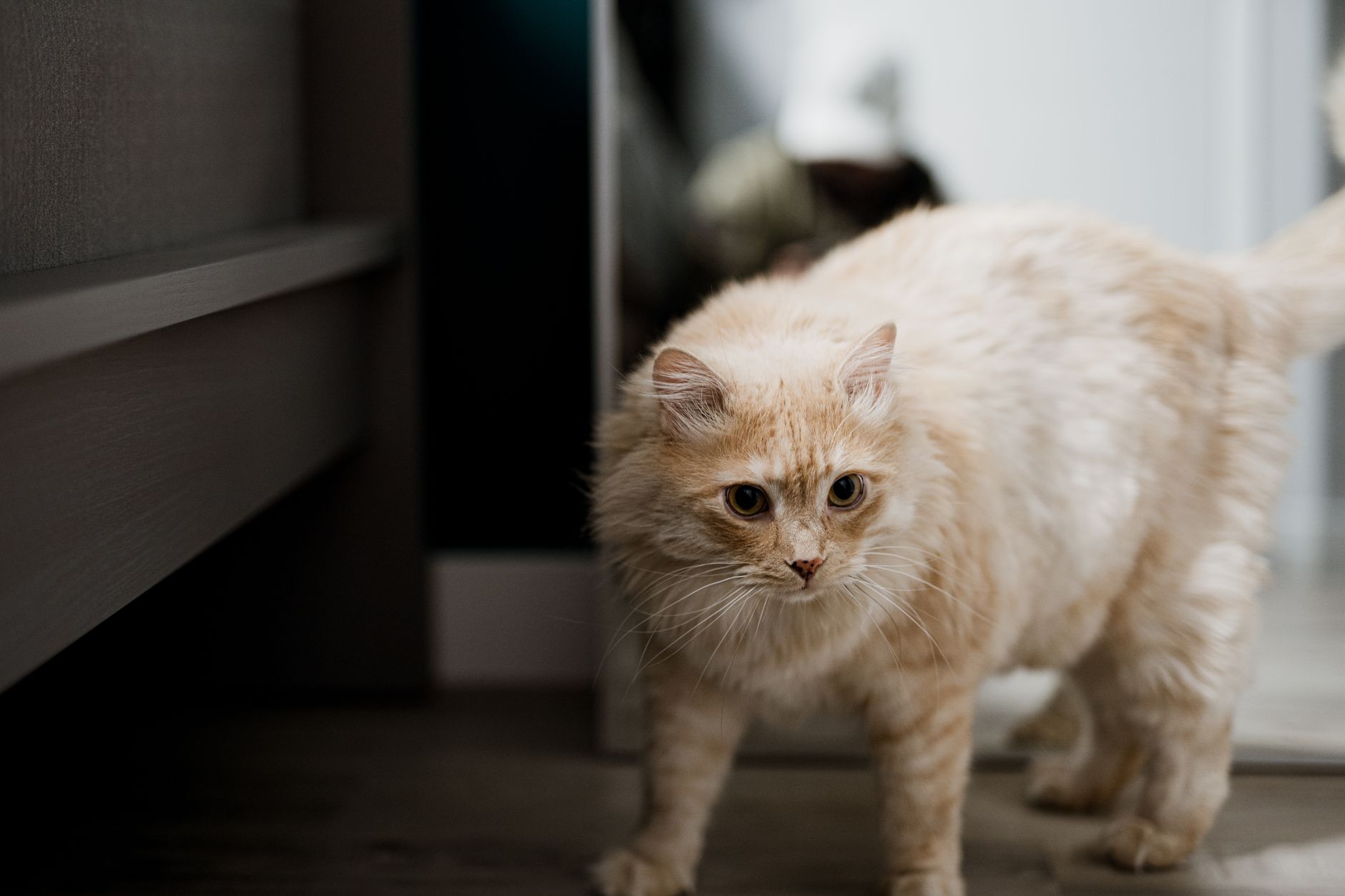
A cat spraying stands upright against a wall or furniture and releases a small amount of urine, while a cat using the litter box normally squats on a horizontal surface to empty its bladder. The difference is about posture and purpose, not just location — one is a bathroom habit, the other is a scent-based message. Mixing the two up is common because both involve urine outside expectations. A cat that sprays still uses its litter box for regular elimination, so a clean box does not rule out marking happening elsewhere in the home, according to the ASPCA.
Table of Contents
- How to Tell Spraying From Normal Urination
- Why Cats Spray
- Why Cats Avoid the Litter Box
- When House Soiling Is a Medical Emergency
- Narrowing Down the Cause
- Frequently Asked Questions
How to Tell Spraying From Normal Urination
The clearest signal is body position. Cornell's Feline Health Center describes a spraying cat as standing with its tail raised against a vertical surface — a wall, door, curtain, or piece of furniture — rather than squatting. A cat using the litter box normally squats low to the ground and voids onto a horizontal surface. Volume matters too.
The ASPCA notes that marking deposits are typically smaller than a normal urine void, since the goal is scent communication rather than emptying the bladder. Watch the cat during the act: a spraying cat often backs up to the target and may twitch its tail or quiver its body as urine is released, a motion sequence that does not occur during ordinary litter box visits. Location is the other giveaway. Spraying lands on vertical surfaces around the home, while normal elimination happens in the litter box or, if the cat is avoiding the box, on a flat surface like a rug, bed, or floor.
Why Cats Spray
Spraying is a communication behavior, not a bathroom accident. The ASPCA estimates that about 10% of cats eliminate outside the litter box at some point, and roughly 30% of those cats are marking rather than avoiding the box — meaning the behavior is deliberate scent-marking, not a sign the litter box itself is the problem. Reproductive status drives most of it. Unneutered male cats spray most often, with unspayed females spraying less frequently, because marking functions partly as reproductive advertising.
The ASPCA names spaying or neutering as a proven way to reduce the behavior for this reason. Stress and household tension also play a role. A study summarized by Vet Candy found that homes with a urine-marking cat showed generally higher overall arousal and stress levels among all the cats living there — not just the one spraying. That finding led researchers to recommend addressing the household's environment as a whole, rather than treating the marking cat in isolation.
Why Cats Avoid the Litter Box
House soiling — urinating or defecating outside the box without the posture or intent of marking — is Cornell's term for the most commonly reported feline behavior problem. Cornell lists three main drivers: an underlying medical condition, aversion to the litter box itself, or a learned preference for eliminating on a different surface. Box aversion often comes down to setup.
AAHA/AAFP guidelines recommend one litter box per cat plus one extra — or one per social group plus one — placed in multiple accessible locations throughout the home. A household that falls short of this ratio, or crowds every box into one room, gives a cat fewer acceptable options and more reason to go elsewhere. A learned surface preference can develop after a single bad experience, such as a dirty box or a startling noise while using it. Once a cat associates the box with something unpleasant, it may consistently choose carpet, bedding, or bathtubs instead, even after the original problem is fixed.
When House Soiling Is a Medical Emergency
Not every break from normal litter box use is behavioral. A cat, especially a male, that strains repeatedly in the box while passing little or no urine may have a urethral blockage, according to YourVetOnline.
This is a life-threatening emergency, not ordinary straining or constipation, and it requires immediate veterinary care. Watch for these warning signs that point to a medical issue rather than marking or preference: Because urethral blockages escalate quickly, any male cat showing straining with minimal output should see a veterinarian the same day rather than being managed as a behavior problem first.
- Repeated trips to the box with little or no urine produced
- Vocalizing, crying, or visible distress while in the box
- Straining that looks like constipation but involves the urinary tract
- Blood in the urine
- Lethargy, vomiting, or loss of appetite alongside box visits
Narrowing Down the Cause
Since spraying, box aversion, and medical emergencies can look similar at a glance, a short review of the evidence helps sort them: Because cats that mark continue to use their litter box normally, the ASPCA's point stands as a practical rule: finding urine in the box does not clear the house of spraying, and finding urine outside the box does not automatically mean the box itself is the problem.
- Vertical surface, small amount, tail raised, body quivering: likely spraying, per Cornell's description of marking posture
- Horizontal surface, normal-looking void, box otherwise used correctly: points to a preference or environmental issue rather than marking
- Frequent box visits with little or no urine, straining, or distress: treat as a possible urethral blockage and seek veterinary care immediately
- Multiple cats, insufficient boxes, or boxes concentrated in one area: check against the AAHA/AAFP ratio of one box per cat plus one extra
Frequently Asked Questions
Can a female cat spray?
Yes. The ASPCA notes unspayed females spray less often than unneutered males, but reproductive status affects both sexes' likelihood of marking.
Does a cat that sprays still use the litter box normally?
Yes. The ASPCA states that cats who mark also use their litter box for regular elimination, so normal box use elsewhere in the home doesn't rule out spraying.
How many litter boxes should a multi-cat household have?
AAHA/AAFP guidelines recommend one box per cat plus one extra, spread across multiple locations, to reduce box-avoidance-driven soiling.