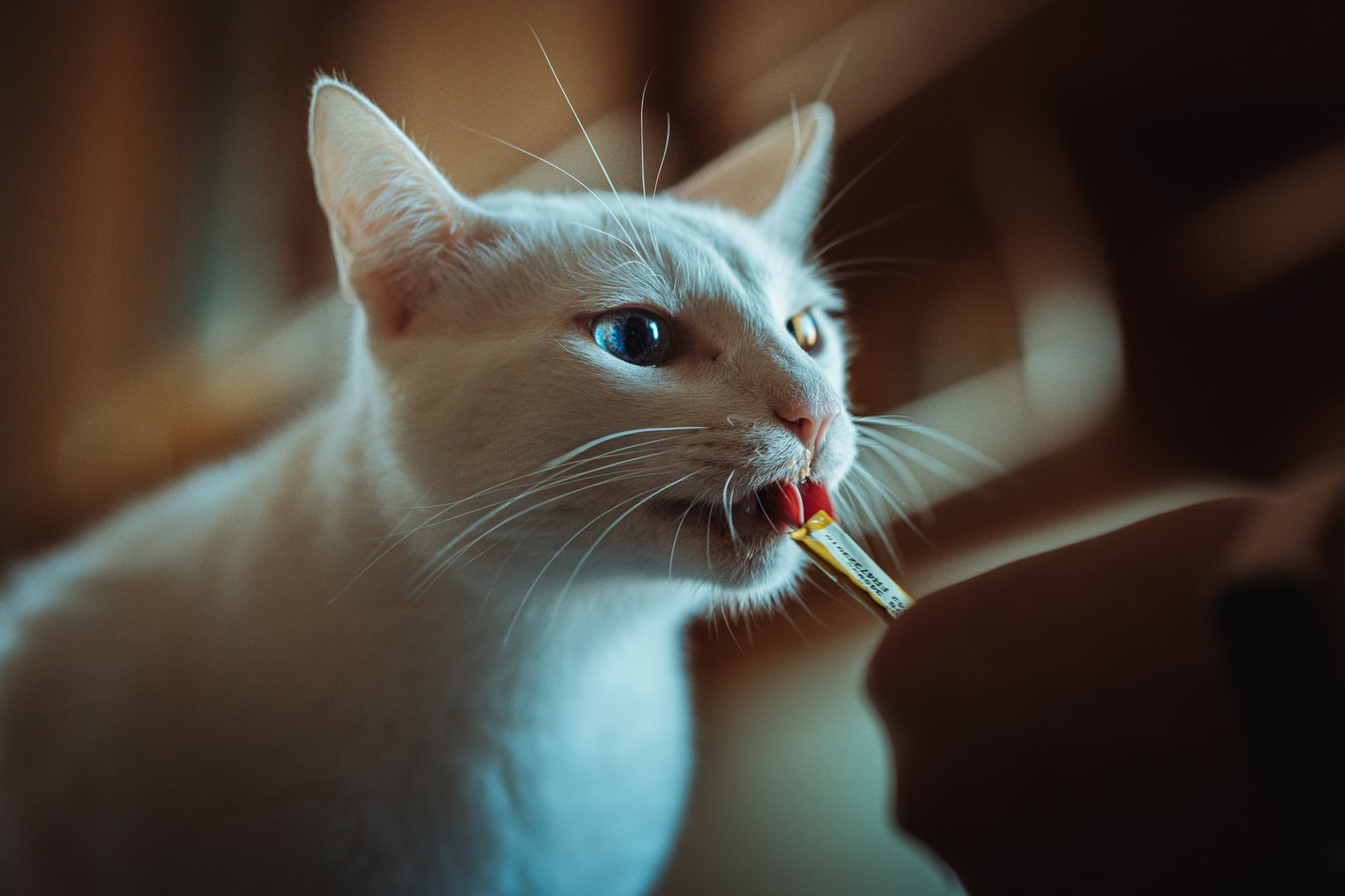
The best treats for a kitten under six months are ones labeled complete and balanced for growth, or tiny portions of the kitten's own food — a few pieces of its kibble, a lick of its wet food — used as a reward. Everything else should be capped at roughly 10% of the day's calories, because a kitten of this age has almost no calorie budget to spare for food that isn't nutritionally complete.
That cap is the whole decision. The 2021 AAHA/AAFP feline life stage guidelines put a 10-week-old kitten's requirement at about 200 kcal per kilogram of body weight per day, against roughly 80 kcal/kg at 10 months. A kitten is building bone, muscle and organs on those calories, so snack calories displace growth calories in a way they never do in an adult cat.
Table of Contents
- Why the 10% rule matters more for a kitten
- Reading the label: what a treat package will and won't tell you
- Milk, raw meat and dental chews: three common choices to skip
- A simple method for treating a kitten this age
- When a kitten won't eat and treats become a problem
- Frequently Asked Questions
Why the 10% rule matters more for a kitten
The Merck Veterinary Manual's small-animal feeding section advises keeping treats under 10% of total daily caloric intake, because most treats are not complete and balanced and a larger share dilutes the nutrient profile of the main diet. Cornell's Feline Health Center gives a similar figure, no more than about 10–15% of daily calories, with the rest from a complete and balanced food. "Complete and balanced" means the product was formulated or tested to supply every nutrient a cat needs at a given life stage.
Merck puts a growth diet at 30–40% protein and 10–35% fat on a dry-matter basis — a dense, specific profile. Dilution is the risk: a kitten eating 20% of its calories as plain chicken or freeze-dried fish is eating 20% of its calories with no calcium-to-phosphorus ratio behind them, during the months its skeleton is forming. Neither figure is a regulation. No AAHA or WSAVA document sets a kitten-specific treat ceiling, so the 10% rule is reference guidance rather than a legal limit — which is exactly why it should be applied against a calorie target your veterinarian sets for your individual kitten, not a number off a bag.
Reading the label: what a treat package will and won't tell you
Under state adoption of AAFCO's model pet food regulations, cat food labels must carry a nutritional adequacy statement — except where the product is conspicuously identified as a "snack" or "treat", and "growth" is listed there as a separate life-stage claim. The practical consequence: a treat package normally carries no growth claim at all, because it is exempt from making one. The clearest negative signal is a specific phrase.
A product that does not meet complete-and-balanced profiles must be labeled "for intermittent or supplemental feeding only" and may not reference AAFCO nutrient profiles. That sentence on the back of a pouch is the manufacturer telling you the item cannot substitute for kitten food. What to look for, in order:.
- A statement that the product is complete and balanced for growth or for all life stages — the only treat that can exceed the 10% share without diluting anything
- "For intermittent or supplemental feeding only" — keep it inside the 10%
- A minimum age on the package, which governs regardless of how the treat is marketed
- Calories per piece or per serving, so the 10% figure is arithmetic rather than a guess
Milk, raw meat and dental chews: three common choices to skip
Cow's milk is the most persistent mistake. Cats lose much of their lactase after weaning, and the undigested lactose ferments and draws water into the gut, producing gas and diarrhea within roughly 8 to 12 hours; the same veterinary commentary calls cow's milk "completely inadequate for kittens" and directs orphaned and very young kittens to a kitten milk replacer (KMR) formulated for them. Raw-meat treats carry a documented pathogen risk, and it is current.
As dvm360 reported from FDA notices, the agency posted a recall on August 28, 2026 for two Northwest Naturals frozen raw products — one of them for cats — after testing found Salmonella and/or Listeria monocytogenes, and in October 2026 warned about two lots of a Darwin's raw chicken recipe for cats that tested positive for Salmonella after two cats fell ill. A kitten's immune system and a household with children or immunocompromised adults are both reasons that risk lands harder here than elsewhere. Dental treats are mostly a later purchase. Permanent teeth erupt as deciduous teeth are shed from around 12 weeks, many feline dental treats specify 1 year and older, and the Veterinary Oral Health Council notes it does not test products itself — its accepted list records submitted claims, so the product's own age limit is the authority.
A simple method for treating a kitten this age
Weaning onto commercial kitten food can begin at 3 to 5 weeks, per the AAHA/AAFP guidelines, so by the time most people are buying treats the kitten already has a complete diet in front of it. The cheapest safe treat is a small measured handful of that diet set aside at the start of the day and given by hand.
That approach solves two problems at once. It keeps treat calories inside the growth profile, and it preserves the thing treats are actually for — training, carrier practice, nail trims, handling. A kitten does not distinguish between a novel snack and a familiar piece of kibble delivered with attention.
- Ask your veterinarian for a daily calorie target at your kitten's current weight, and recheck it monthly as the requirement per kilogram falls
- Take 10% of that number as the treat allowance, and count every item against it, including a lick of wet food
- Offer one new item at a time and wait a day before adding another, so a loose stool has an identifiable cause
- Treat water and a complete kitten food as the baseline, and milk replacer only where a kitten is orphaned or still pre-weaning
When a kitten won't eat and treats become a problem
Using treats to tempt a poor eater inverts the ratio fast, and in a kitten that is a nutritional issue within days rather than weeks — the 200 kcal/kg figure leaves no margin. A kitten refusing its food is a reason to call a veterinarian, not a reason to find a tastier snack.
The safer tactic is to make the complete food more appealing rather than replacing it: warming wet food, offering it more often in smaller amounts, or asking about a different growth formula. If something palatable is needed for medication or recovery, a product labeled complete and balanced for growth keeps the calories doing both jobs at once.
Frequently Asked Questions
Can a kitten under six months have cat treats made for adult cats?
Only within the 10% allowance, and only if the package sets no minimum age. Many feline dental treats specify 1 year and older, and that label limit governs.
Are freeze-dried meat treats safe for kittens?
Treat anything raw as a pathogen risk. FDA notices in 2026 covered raw cat products contaminated with Salmonella and Listeria, including two Darwin's lots flagged after two cats fell ill.
How many treats is 10% of a kitten's daily calories?
It depends entirely on the kitten's weight and your veterinarian's calorie target, then divided by the calories per piece printed on the package — the share is fixed, the piece count is not.
What should I give an orphaned kitten instead of milk?
A kitten milk replacer formulated for cats. Cow's milk produces gas and diarrhea within roughly 8 to 12 hours once lactase declines after weaning.