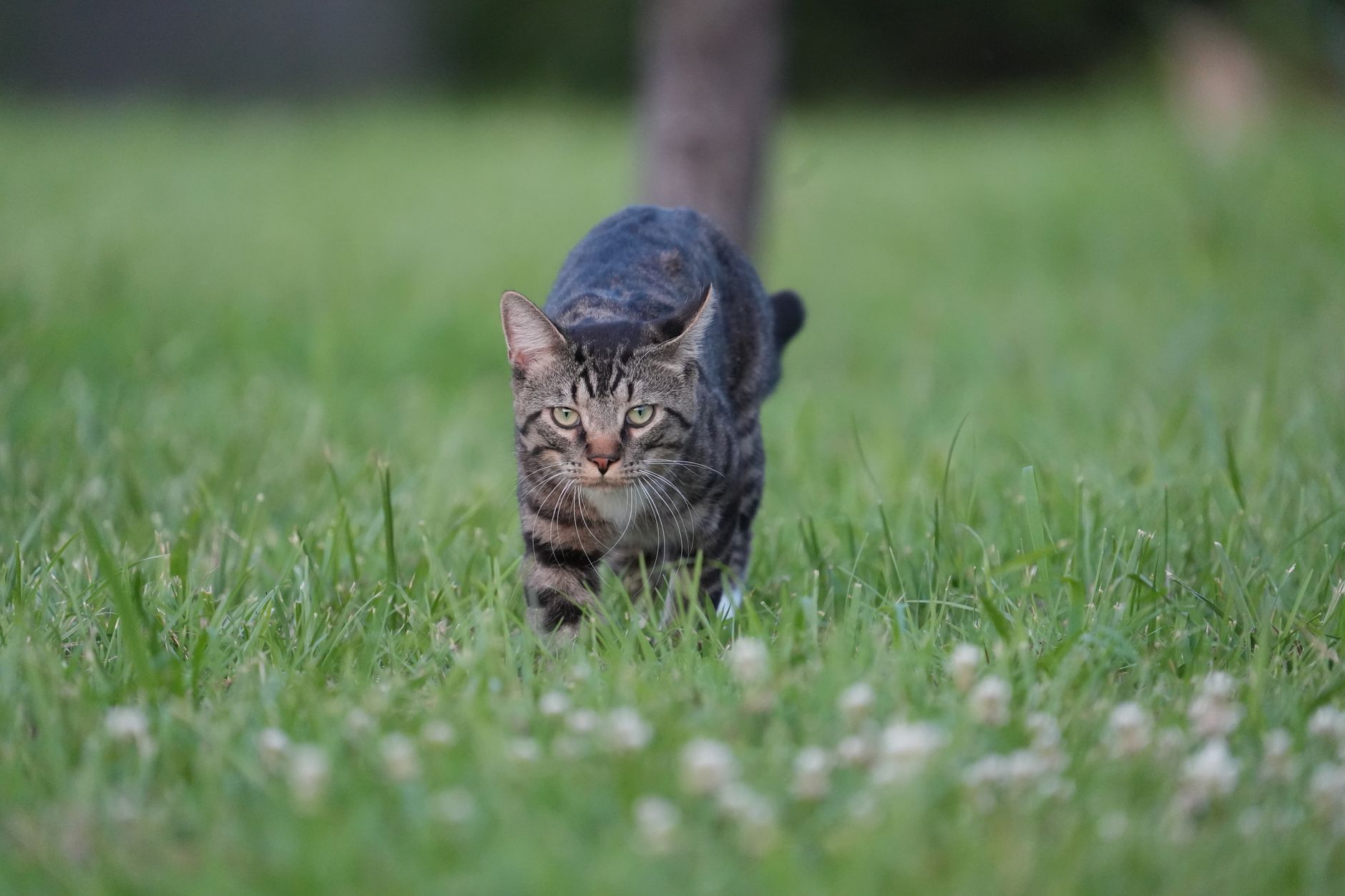
A cat's hunting pose — the low crouch, extended head, fixed stare and slow creep — is the opening move of a hardwired predatory sequence, not a sign that your cat is hungry or angry. It means the cat has locked onto a target and is positioning itself for the final spring, whether that target is a mouse, a moth or your shoelace. Understanding the pose matters for two practical reasons. It tells you when your cat wants to play rather than fight, and it tells you when a crouching cat is actually frightened instead — a different posture that looks superficially similar and calls for the opposite response.
Table of Contents
- The sequence the pose belongs to
- It is not a hunger signal
- Why your cat does it to a feather wand
- Hunting crouch or frightened crouch?
- Letting the pose finish
- Frequently Asked Questions
The sequence the pose belongs to
Hunting in cats is a fixed series of actions rather than an improvised chase. According to International Cat Care's guidance on feline hunting behaviour, a cat stalks prey low to the ground with its head extended and its movements slow, stops when it is close enough, prepares, then springs forward and strikes with one or both front paws. The pause is the part people misread as hesitation.
Purina's behaviour guidance notes that the approach may involve stopping several times, sometimes with one paw held up in the air, so the cat can stay completely motionless while alert prey is watching. A cat frozen mid-step with a raised paw has not lost its nerve; it is waiting out the target. The strike itself ends in a bite to the neck. A cat's two long canines are spaced to slide between vertebrae and sever the spinal cord, and in domestic cats those canines sit narrowly apart relative to jaw size — an adaptation to small rodents with small vertebrae, as summarised in the Wikipedia overview of the cat.
It is not a hunger signal
The most common misreading is that a stalking cat is asking to be fed. International Cat Care describes hunting as opportunistic rather than appetite-driven: prey is not available on demand, so cats hunt whenever the chance appears, regardless of whether they are hungry at that moment. A well-fed indoor cat will still stalk a bottle cap across the kitchen floor.
That also explains the patience. International Cat Care puts the success rate of any single hunting attempt at under 50%, which is why a free-living cat has to make many attempts a day. A pose held for two minutes over a gap under the sofa is a cat budgeting for likely failure, not one that has forgotten what it was doing.
Why your cat does it to a feather wand
The crouch you see at a toy is the same motor pattern, not an imitation of it. International Cat Care's advice on playing with your cat covers the full predatory sequence — search, stalk, chase, pounce, catch and manipulate — and recommends short, frequent sessions because that is how the natural pattern runs. Cats are built for many brief bursts, not one long game. The overlap has been measured.
In a trial by Cecchetti, Crowley, Goodwin and McDonald published in Current Biology in February 2021, five to ten minutes of daily object play with a feather wand plus a toy mouse for the cat to "kill" reduced the prey cats brought home by about 25%. A high-meat-content food did more, cutting returns by roughly 36%. Two limits are worth knowing before you treat those numbers as a wildlife plan. The study counted only prey brought home, so animals eaten or left outdoors never entered the tally — and as the ScienceDaily summary of the Exeter research records, the same group found puzzle feeders *increased* returned prey by about 33%. Enrichment is not interchangeable; the specific intervention matters.
Hunting crouch or frightened crouch?
A low body alone tells you nothing. Welfare guidance from the Arizona Humane Society's feline body language guide separates the two postures by the details above the shoulders: The response differs completely. A hunting cat wants the toy moved — away from it, like fleeing prey, so the sequence can finish.
A frightened cat wants distance, a clear exit route and no eye contact, and reaching for it with a wand makes things worse. Scanning eyes are the fastest tell. A target-locked stare means predator; eyes tracking the whole room mean the cat is looking for what to avoid.
- **Hunting:** ears swivelled forward, whiskers pushed forward, pupils locked on one target, rear end wiggling just before the leap.
- **Fear:** body compacted, paws tucked under, head held below the shoulder line, ears flattened, whiskers pulled back, eyes wide and scanning the room rather than fixed.
Letting the pose finish
A stalk that never reaches a catch leaves the sequence open, which is why cats redirect onto ankles and hands. Give the pattern somewhere to end: drag the toy out of sight behind furniture so the cat has something to search for, let it corner the toy, and finish with a mouse-sized object it can grab, bite and kick with its back feet.
Keep sessions to the five-to-ten-minute range used in the Current Biology trial and run them more than once a day rather than stretching one into half an hour. Stop while the cat is still engaged — and never use a laser pointer as the only toy, since the dot cannot be caught, so the sequence has no ending at all.
Frequently Asked Questions
Why does my cat freeze with one paw lifted?
Purina's behaviour guidance describes this as part of the stalk — the cat stops mid-approach and holds still so alert prey does not detect movement.
Does the hunting pose mean my cat is about to attack me?
It means a target has been selected, which can be your moving foot. Redirect it onto a toy rather than pulling away, since retreat looks like fleeing prey.
Will feeding my cat more stop it hunting?
Not by volume. International Cat Care describes hunting as opportunistic rather than appetite-driven, though the Current Biology trial found a high-meat-content food cut prey brought home by about 36%.