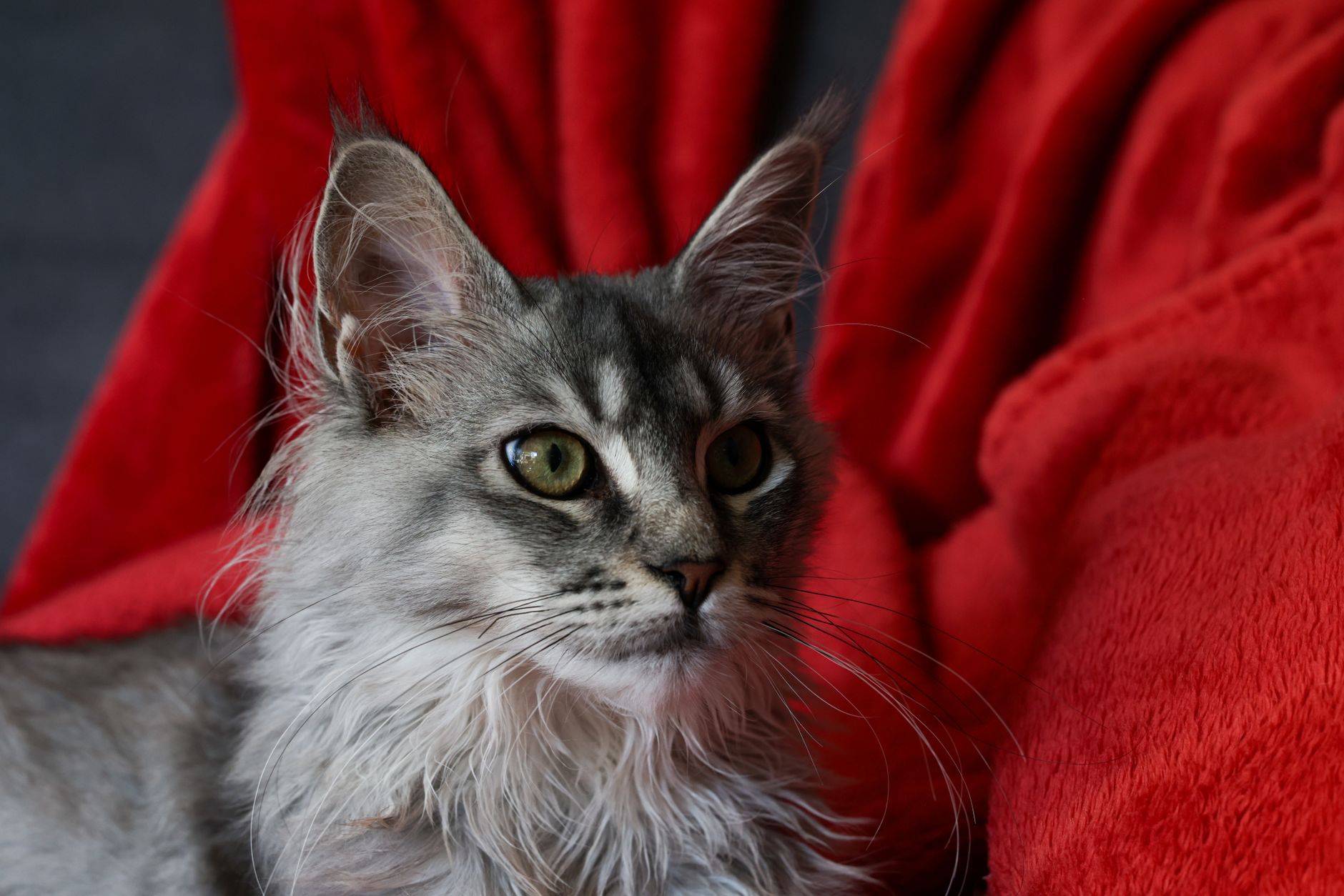
A healthy adult Maine Coon can play with some kitten toys, but many of them are unsafe for a cat that size. The problem is not the play — it is that toys built for a three-pound kitten are small enough for a fifteen-to-twenty-two-pound cat to swallow whole, and sturdy enough for a kitten's bite but not a Maine Coon's. Maine Coons are one of the largest domestic cat breeds, and they keep a kitten-like appetite for chasing and pouncing well into adulthood. That combination — big jaws, long reach, and persistent play drive — changes which toys are appropriate, even though the behavior looks the same as a kitten's.
Table of Contents
- The size rule that decides most of it
- Which kitten toys to retire outright
- Why string toys are the sharpest risk
- The play space matters more for a big cat
- What to watch for, and when to call
- Frequently Asked Questions
The size rule that decides most of it
Veterinarian Dr. Erin Ray, writing for Texas A&M's Pet Talk series, gives the sizing standard plainly: a toy should not be small enough to swallow or fit whole into the mouth, and not so large the animal cannot comfortably chew it. Most kitten toys fail the first half of that test for an adult Maine Coon. A mouse, pompom, or jingle ball scaled for a kitten disappears into a Maine Coon's mouth.
That is the moment the toy stops being a toy. Dr. James Barr of Texas A&M reports in "Biting off more than they can chew" that pets most often swallow objects too big to pass, which then lodge in the esophagus, stomach, or intestines. That is the key asymmetry. A kitten-sized ball can fit comfortably in a Maine Coon's mouth and still be far too large to travel through its gut — fitting in the mouth is not the same as passing safely.
Which kitten toys to retire outright
Some categories are not worth salvaging. Cornell's Feline Health Center advises in its guidance on safe toys and gifts that owners avoid toys with small pieces or linear, strand-like parts such as feathers and string, which can separate from the toy — especially when chewed — and be swallowed. Kitten toys are built almost entirely from those parts: glued feathers, crimped bells, pompoms, ribbon tails.
Plush is the other category. Texas A&M warns that squeakers inside plush toys can be swallowed and cause gastrointestinal obstruction, and advises that pets which destroy their toys skip soft, plush, and squeaker toys entirely. A Maine Coon's jaw strength makes shredding a small plush mouse a likely outcome rather than an unlucky one. A quick sort of a kitten toy bin:.
- Retire: small plush mice, squeaker toys, anything with glued-on feathers, bells, or pompoms
- Retire: balls that fit entirely inside the cat's mouth, including jingle balls and foam practice balls
- Keep with supervision only: wand and teaser toys, put away after each session
- Keep: large, solid, one-piece toys with no detachable parts and nothing to shred
Why string toys are the sharpest risk
String, ribbon, and tinsel belong in their own category. Cornell classifies them as linear foreign bodies that, if swallowed, can cause partial or complete intestinal obstruction and perforation requiring emergency surgery — described in the center's guidance on holiday hazards. This is the most severe outcome of a cat ingesting part of a toy.
VCA Animal Hospitals takes the same line a step further, advising that any string or ribbon play happen only under direct supervision and recommending that owners not encourage it at all, favoring toys designed for chase and pounce instead. That is the practical rule for the kitten wand toys sitting in most households: use them with a person holding the handle, then put them away out of reach. The danger is not the chase. It is the unattended string left on the floor afterward.
The play space matters more for a big cat
Cornell's safe-toy guidance also tells owners to assess the environment a cat plays in, checking that nothing heavy can be knocked down during play. For a Maine Coon this is not a formality. A cat with that reach and body mass can shift a lamp, a shelf bracket, or a framed picture that a kitten would only brush past.
Clear the surfaces a cat will launch from and land on before an energetic session, not after. The same throw-and-chase game that was harmless when the cat weighed four pounds has different consequences at twenty. Cornell also offers a useful fallback when no cat-specific standard exists for a given item: if something is not safe for a child, it is not safe for a cat. Small detachable parts and swallowable pieces fail that test for both.
What to watch for, and when to call
If a toy or a piece of one goes missing after play, treat that as the trigger. Dr. Ray advises owners to consult a veterinarian when they suspect a pet has ingested any portion of a toy, rather than waiting for symptoms to appear.
Signs of obstruction, per the same Texas A&M guidance, include vomiting, lethargy, reduced appetite, and abdominal pain. These can take time to develop, which is exactly why a missing bell or feather is worth a phone call on its own. Do a quick count when a session ends. Knowing that a toy left the floor intact is the cheapest diagnostic available, and it is the one most owners skip.
Frequently Asked Questions
My Maine Coon has played with kitten toys for years without a problem. Should I change anything?
Past safety is not a guarantee. Texas A&M's guidance is specific that pets which destroy their toys should avoid plush and squeaker types entirely, and a single swallowed squeaker or bell is enough to cause an obstruction.
Are kitten wand toys safe if I only use them when I'm there?
VCA recommends that string or ribbon play happen only under direct supervision, and suggests not encouraging it at all in favor of chase-and-pounce toys. Supervision is the minimum, not the ideal.
Does a Maine Coon kitten need the same rules as an adult?
The sizing rule scales with the cat, not the breed. Texas A&M's standard — not swallowable, not too large to chew comfortably — means toys that fit a Maine Coon kitten need reassessing as it grows.