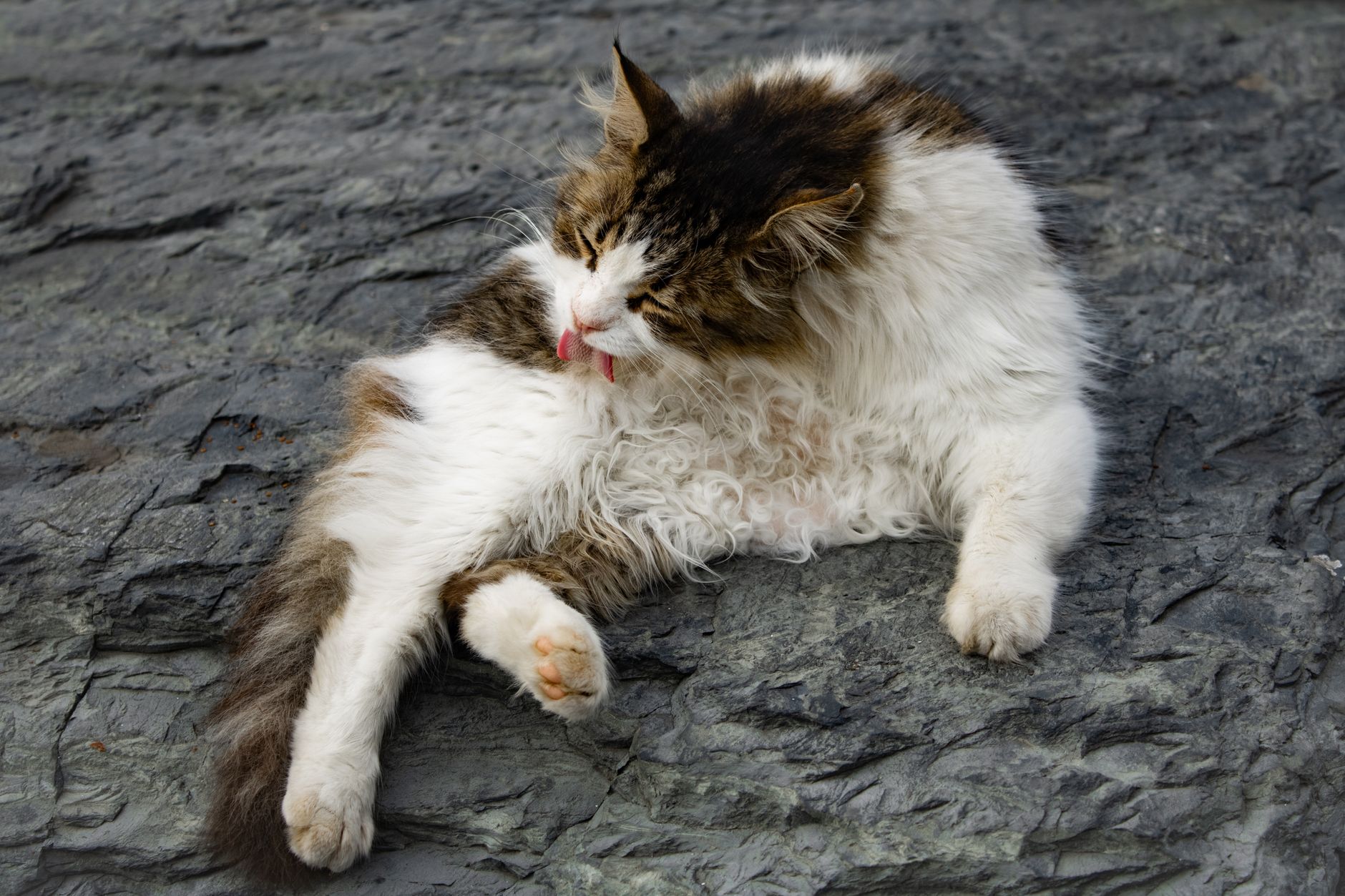
One cat grooming another does not, by itself, mean dominance or aggression. Domestic cats do not follow a simple social hierarchy, and allogrooming—the grooming of another cat—is often friendly but can also occur during tension. The key is to assess the cats' posture, relationship, and behavior before and after the licking. A relaxed exchange suggests affiliation; staring, stiff postures, blocking, striking, or biting points toward conflict.
Table of Contents
- What relaxed social grooming looks like
- When grooming becomes tense
- Does one cat groom another to show dominance?
- Read the quieter conflict signals
- What caregivers should do
What relaxed social grooming looks like
Affiliative behavior maintains a friendly social connection. The Feline Veterinary Medical Association describes cat social organization as based on familiarity, age, and affiliations rather than a simple rank hierarchy, and it treats allogrooming as an affiliative sign.
Look for the following signs during and around grooming: Consider the broader relationship. cats that regularly touch or sleep together and remain relaxed after grooming provide stronger evidence of affiliation than licking alone.
- Relaxed bodies
- Forward-facing ears
- Partly or fully closed eyes
- Comfortable physical contact
- Resting or sleeping together
When grooming becomes tense
Grooming can occur during social friction. An August 2026 observational study of 53 cat pairs found allogrooming in both friendly and tense situations, with tense episodes involving unequal postures, backward-rotated ears, displacement behavior, striking, and biting. Watch the interaction as a sequence.
A cat may initially tolerate licking but then turn its ears backward, stiffen, pull away, strike, or bite. Those changes matter more than the grooming label. An unequal posture can also be informative. If one cat remains comfortable while the other crouches, tries to leave, or appears unable to disengage, treat the interaction as possible tension rather than mutual relaxation.
Does one cat groom another to show dominance?
Sometimes allogrooming accompanies an unequal or tense interaction, but grooming does not prove a dominance motive. Researchers can record posture and behavior, yet they cannot directly determine what the grooming cat intended. A 1998 study of 25 neutered adult cats in a confined group found that higher-ranking cats groomed lower-ranking cats more often.
Agonistic behavior appeared in 35% of 83 grooming interactions, supporting a possible tension-related function in that setting. The study does not justify treating every household grooming session as a rank display. Its cats lived in a confined research group, so its findings have limited generalizability to individual multi-cat homes.
Read the quieter conflict signals
Conflict between cats is not always loud or physical. Ohio State University's Indoor Pet Initiative identifies staring, stalking, blocking access, refusing to back away, and denying access to food or litter boxes as possible assertive signals. The threatened cat may yield the resource, hide, crouch, or flee.
If these patterns appear around grooming, the licking may be one part of a larger tense relationship. More obvious aggressive arousal can include dilated pupils, flattened ears, raised fur, an arched back, and an erect tail. Cornell University notes that fear can look similar, but it more often includes a low or prone body and a tucked tail.
What caregivers should do
Observe what happens before, during, and after grooming: Separate the cats when striking, biting, or another behavior creates an injury risk. Reduce competition by placing resources in dispersed locations and adding visual barriers that let cats avoid continuous contact.
Seek veterinary assessment when aggression develops or persists. Pain or illness can contribute to aggressive behavior and should not be dismissed as a social-ranking problem.
- Note whether both cats begin and remain relaxed.
- Watch for staring, blocking, stiffening, flattened ears, or attempts to escape.
- Check whether either cat loses access to food or litter boxes.
- Record recurring patterns, including which cat approaches and how each interaction ends.