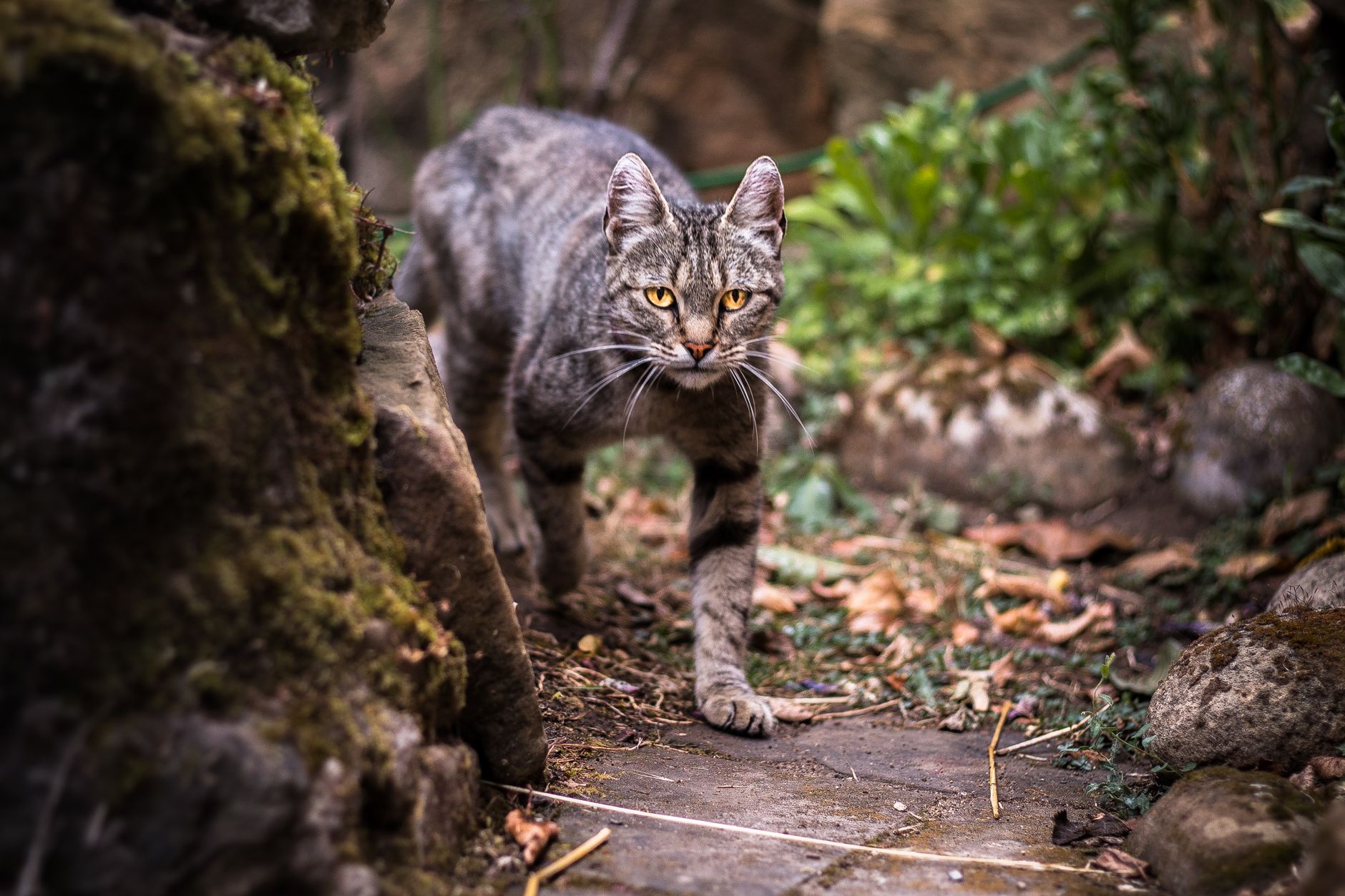
Cat hunting is your cat's built-in predatory sequence — stalking, chasing, pouncing, and killing — and it runs on opportunity, not hunger, so a full food bowl does not switch it off. The most reliable "care options" backed by trials are a high-meat diet and short daily play sessions, plus daily litter removal to manage the one real health risk to your household. This guide explains why cats hunt, what actually reduces it, the health and wildlife stakes, and the specific questions to ask before you change anything. It uses only measured findings, and flags where popular fixes fail.
Table of Contents
- Why does a well-fed cat still hunt?
- What reduces hunting — and what doesn't
- Protecting birds specifically
- The health risk to your household
- Questions to ask before you change anything
- Frequently Asked Questions
Why does a well-fed cat still hunt?
hunting is instinct, not a response to an empty stomach. According to International Cat Care, cats are obligate hunters whose stalk-chase-pounce-kill sequence is triggered by opportunity, so well-fed cats still hunt. Feeding more will not correct it. This matters because owners often read hunting as a sign of hunger or poor feeding.
It is neither. A cat that catches mice while eating a full diet is behaving normally, so the goal is to redirect the drive, not to shame or starve the cat. The practical takeaway: treat hunting as a need to satisfy, not a fault to punish. The sections below cover what redirection actually works.
What reduces hunting — and what doesn't
A large UK trial gives clear, ranked answers. In a 12-week study of 355 cats across 219 households, Cecchetti and colleagues in Current Biology found switching to a high-meat, grain-free food cut prey brought home by 36%, and 5–10 minutes of daily object play cut it by 25%, against controls.
Other popular fixes performed worse or backfired. In the same trial, a bell on the collar had no measurable effect, and puzzle feeders increased prey brought home by 33% — apparently frustrating some cats rather than satisfying them. So "enrichment" is not automatically helpful; the type matters.
- Works best: high-meat, grain-free diet (−36%)
- Works: 5–10 minutes daily play with a wand or toy (−25%)
- No effect: attaching a bell
- Backfired: puzzle/food-dispensing feeders (+33%)
Protecting birds specifically
If your concern is birds, one tool stands out. In the trial, a colorful Birdsbesafe collar cover reduced birds captured by 42%, per Cecchetti and colleagues. The bright ruff makes a stalking cat visible to birds, which see color well. Note the limit clearly: the collar cover reduced bird captures but did not affect mammal kills.
It solves one problem, not both, so pair it with the diet-and-play approach if your cat also catches rodents. The wildlife stakes are large. Loss, Will, and Marra in Nature Communications estimated free-ranging U.S. cats kill 1.3–4.0 billion birds and 6.3–22.3 billion mammals a year — likely the largest human-linked source of this mortality. About 69% of bird kills came from un-owned stray and feral cats, so owned-cat measures address a real but smaller share.
The health risk to your household
Hunting carries one health issue worth understanding: toxoplasmosis. Cats commonly pick up the parasite *Toxoplasma gondii* by eating infected rodents or birds. Per the Cornell Feline Health Center, an infected cat sheds oocysts in feces for up to about two weeks, and those oocysts need 1–5 days to become infectious. That timing is the whole defense: removing feces every day, before oocysts mature, prevents transmission.
Human risk from a cat is actually very small — most people are infected through undercooked meat or contaminated soil, not their pet. The exception is serious. Cornell notes pregnant and immunocompromised people face real danger and should avoid changing litter, or have it done daily by someone else. This is a genuine warning, not general caution.
Questions to ask before you change anything
Use these to pick the right intervention instead of guessing: A welfare-focused approach is also the evidence-based one. A related study in Mammal Review linked hiding places, litter boxes, and enrichment to fewer prey returned — pointing to indoor enrichment over punishment.
- What is my cat actually catching — birds, mammals, or both? Diet and play cut overall prey; the collar cover targets birds only.
- Is my cat's food high in meat and grain-free? If not, that is the single biggest lever.
- Am I playing 5–10 minutes daily? Short, consistent object play beat longer, occasional sessions.
- Am I about to add a puzzle feeder? Evidence says it may raise hunting, so watch prey returns if you do.
- Who removes the litter, and how often? Daily removal is the toxoplasmosis safeguard; a pregnant or immunocompromised person should not do it.
Frequently Asked Questions
Will a bell on my cat's collar stop the hunting?
No. In the UK trial, attaching a bell had no measurable effect on prey brought home. Diet and daily play worked; the bell did not.
Are food puzzles a good way to reduce hunting?
Not in this study — puzzle feeders increased prey brought home by 33%, apparently frustrating some cats. Choose wand play and a high-meat diet instead, and monitor if you use puzzles.
Can I catch toxoplasmosis from my hunting cat?
The risk is very small for most people, since infection usually comes from undercooked meat or soil. Remove litter daily, and if you are pregnant or immunocompromised, have someone else do it.