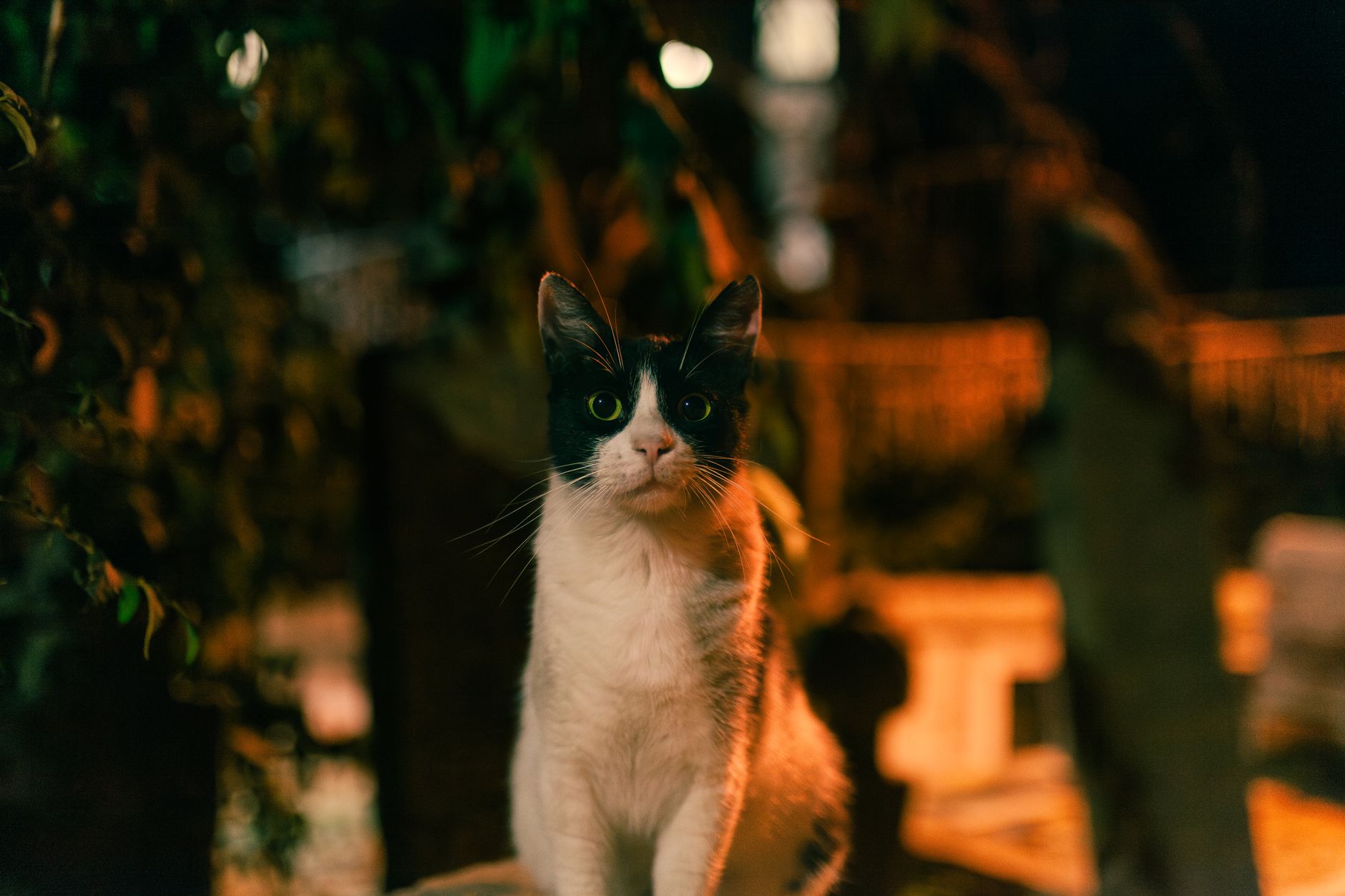
Your cat is almost certainly crepuscular, not nocturnal — most active in the hours around dawn and dusk rather than through the whole night. The best available tracking data points the same way: when researchers watched 14 indoor cats around the clock for a week using RFID tags, automated feeders and location telemetry, they found two activity peaks, one before sunrise and one in the evening before sunset, and two troughs at midday and midnight. That is the signature of a twilight animal, not a night animal.
"Crepuscular" simply means active at twilight. It explains the 5 a.m. sprint down the hallway, the pre-dinner ambush on your ankles, and the fact that your cat sleeps through most of the afternoon and much of the deep night too. It also explains why the fix for a cat that wakes you is usually a timing change rather than a discipline problem.
Table of Contents
- What the tracking data actually shows
- Why your cat still seems to own the night
- Working with the rhythm instead of against it
- What not to do when you are woken
- When night activity is a medical sign, not a rhythm
- The limits of this evidence
- Frequently Asked Questions
What the tracking data actually shows
The clearest measurements come from a group of indoor cats observed continuously for seven days. Writing in *Animal Biotelemetry*, Parker and colleagues concluded that cats are crepuscular rather than nocturnal, with peaks tied to sunrise and the evening before sunset. The same team also tested whether individual cats sort into "night cats" and "day cats." They reported that no general pattern emerged along a nocturnal-versus-diurnal split, and that bimodality — two peaks a day — characterises the species better than chronotypes do.
In plain terms: labelling your own cat a night animal is not a useful description of its biology. A follow-up study compared cats in a small indoor room with cats in a large outdoor enclosure, roughly 29 square metres against 1,145. Both groups showed the same two-peak pattern, with twilight triggering the peaks, though the outdoor cats were less rhythmic overall because of disruptions that only exist outside.
Why your cat still seems to own the night
Household feeding is the biggest modifier of this rhythm. A radio-telemetry study of 42 free-roaming cats near Champaign-Urbana, Illinois, found that unowned cats were more nocturnal and more active overall than owned cats, whose activity spread more evenly across the day. The authors tied that difference to supplemental feeding and reliable shelter. The intensity numbers are worth keeping in perspective.
In that study, pet cats spent only about 3% of their time in highly active pursuits such as running or stalking, against 14% for unowned cats. Your cat's dawn burst feels enormous because you are asleep for it, but it is a small slice of a day otherwise spent resting. A second reason the night feels busy is simply contrast. Nothing else is moving at 4:45 a.m., so a cat trotting across a wooden floor registers as a major event.
Working with the rhythm instead of against it
Because the peaks are predictable, they can be scheduled around. Cornell University College of Veterinary Medicine notes that cats hunt and play most in the evening and early morning, and that a play session before bed or early in the morning works with that rhythm rather than fighting it.
Meal timing is the other lever. VCA Animal Hospitals' guidance on nocturnal activity says shifting the timing or type of a cat's meals a few hours earlier or later can be enough for the cat to sleep through the night. Things to try, roughly in order of effort:.
- Move the main interactive play session to just before your bedtime, so the evening peak is spent.
- Shift dinner later, or split it, so the cat is not empty by 4 a.m.
- Set an automatic feeder for around 5 a.m. if your cat wakes demanding food — VCA suggests this for early risers.
- Never hand-feed during the night; it teaches the cat that waking you produces food.
- Give the morning peak somewhere to go: a window perch, a puzzle feeder, a toy left out overnight.
What not to do when you are woken
Attention is the reward, and it does not have to be affectionate attention to count. The RSPCA advises not getting up and not interacting when a cat wakes you, because food, affection or any engagement reinforces the waking. That means the hard part is consistency.
A cat that is ignored for six nights and fed on the seventh has learned that persistence pays, which is a stronger lesson than the six quiet nights taught. Expect it to get briefly worse before it gets better. Behaviour that has been working for months does not stop at the first night it fails.
When night activity is a medical sign, not a rhythm
A change in pattern matters more than the pattern itself. VCA notes that older cats with sensory dysfunction and geriatric cognitive decline wake more at night and vocalise more, so a senior cat that has newly become night-active needs a veterinary workup — thyroid disease, hypertension, kidney disease, pain and sensory loss all belong on that list — before twilight biology takes the blame. Signs that point toward a vet visit rather than a schedule change:.
- The cat is over about 10 and the night waking is new.
- Loud, disoriented vocalising, especially in an empty room or at a wall.
- Night activity alongside weight loss, increased drinking, or a changed appetite.
- Pacing or restlessness that does not settle after the usual dawn peak passes.
The limits of this evidence
The strongest rhythm data come from small captive groups: 14 free-fed cats in a single room in the 2019 study, and two enclosure groups in 2022. Those settings control light and food precisely, which is what makes the twilight signal so clean — and also what makes it an inference when applied to your living room. An ordinary home differs in ways that plausibly shift timing by an hour or more: artificial light late into the evening, a human who leaves at 7 a.m.
and returns at 6 p.m., scheduled rather than free-choice meals. The two-peak shape is well supported; the exact clock times in your house are not something anyone has measured. Track your own cat for a week before concluding its schedule is unusual.
Frequently Asked Questions
Can I retrain my cat to sleep when I do?
Partly. You can shift the peaks with meal and play timing, but you cannot remove them — the bimodal pattern held even for cats in a large outdoor enclosure.
Do kittens follow the same pattern?
The published rhythm work was done on adult cats. Kittens sleep and wake in shorter cycles overall, so expect more scattered activity until the adult twilight pattern settles.
Is it cruel to ignore a cat crying at night?
No, provided food, water, litter and warmth are available and the cat is healthy. The RSPCA's advice to avoid interacting exists because responding is what maintains the behaviour.
Will a second cat help or make it worse?
It can go either way, and nothing in this evidence predicts which. Two cats on the same twilight schedule can entertain each other, or wake each other — and then you.