You can keep using minoxidil with cats in the house, and the American Academy of Dermatology says so in as many words, but only if you control where the drug goes once it leaves the bottle. In the largest published set of pet cases, the commonest way a cat was exposed was during the owner’s own treatment: the cat licked the owner’s skin or pillowcase, or got splashed when the product spilled.
So this guide follows the drug around a normal home, stop by stop: your hands, your scalp and hair, the pillowcase and sofa, the bathroom surfaces, the bin, and the shelf where the bottle lives. Each stop has its own habit that cuts the risk. None of these habits has been tested in a study, and no source gives a waiting time after which a treated scalp is harmless to a cat, so think of them as layers that add up rather than a single fix.
If your cat has licked, eaten or been splashed with minoxidil, call your veterinarian or an emergency animal hospital now, even if your cat seems fine. Two animal poison control centers answer around the clock: the ASPCA Animal Poison Control Center at (888) 426-4435 and Pet Poison Helpline at (855) 764-7661. Both may charge a consultation fee.
Why using minoxidil with cats comes down to where the drug goes
Hardly any of a scalp dose ends up inside you. Dermatologists reviewing the drug in 2022 for the Journal of Dermatological Treatment wrote that “Approximately 1.4% of topical minoxidil is absorbed through the skin.” The rest stays on your scalp and hair until soap and water remove it, and in the meantime fingers, fabric and fur can pick it up.
Cats do not need much. The ASPCA poison control review of 211 dog and cat exposures found signs of poisoning “even with low exposure amounts, such as drops or licks,” and the ASPCA says “Cats are more sensitive to the effects of minoxidil than dogs and even very small exposures can cause life-threatening complications.” In the UK, Sarah Merrett of the charity Cats Protection told Vet Times: “Direct ingestion from bottles or applicators is uncommon. Most poisonings occur through everyday, unintended contact with owners.”
That is the case for organizing your routine by route rather than by rule. Our pillar page, is minoxidil toxic to cats?, covers what the drug does to a cat’s blood pressure and heart; this page stays with keeping it off your cat in the first place.
On you: hands, scalp, hair and beard
Hands
Your fingers touch the drug first and your cat second. The Rogaine foam label’s directions end with “massage into scalp with fingers, then wash hands well.” The men’s 5% solution, which tells you to “apply one mL with dropper 2 times a day directly onto the scalp in the hair loss area,” has no hand-washing line and no pet warning on its DailyMed label (read October 8, 2026), so do not take its silence as permission.
The American Academy of Dermatology is blunt about why washing matters: “Even a small amount of minoxidil on your hands can be toxic to your pet if you touch them or they lick you.” It adds: “When washing your hands, wash for at least 20 seconds.” The ASPCA asks for the same, “immediately after application of topical products,” and wants the whole job done “in a closed room, away from pets.”
The habit that follows: shut the bathroom door with the cat outside, apply, wash at the sink, and only then open the door. Later in the day, every time you smooth or scratch treated hair, your fingertips gather a little of the drug again. A second wash before you feed, brush or pick up your cat closes that gap.
Scalp, hair and beard
Treated hair is easy to forget about, because it carries the drug for the whole time you are on treatment. Pet Poison Helpline published the case of Kratos, whose owner said: “After I apply the minoxidil, I usually wear a hat, but it was my day off and I sat down on the couch.” Kratos jumped up beside him and licked his head. “It had been 15-20 minutes since I applied the medication, so I didn’t know how dry it was or what the danger could be.” The helpline advised taking Kratos to a hospital, and “Fortunately, he made a full recovery.”
The second case had nothing to do with a fresh application. Writing in the Journal of Veterinary Cardiology in 2025, vets described a young Russian blue cat with two bouts of heart failure. Only after the second did anyone connect them: both “appeared after contact with a family member who was using minoxidil to treat androgenic alopecia and whose hair the cat had insistently licked.” The report stops short of proof and names the drug a likely contributor. So the route runs through everyone in the home who uses minoxidil, not just you.
Beards are on the list as well: a review in Vet Times names “licking a person’s freshly treated scalp, beard or hands” among the ways pets have been exposed.
How long until treated hair stops mattering? Nobody has published a figure: not the labels, not the case reports, not the poison centers. The ASPCA’s only timing advice is to “Ensure topical products dry completely prior to interacting with pets,” and dry hair still carries the drug until it is washed. Our page on how long after applying minoxidil you can touch your cat goes through that question contact by contact.
In practice, the AAD’s rule covers it: “Stop your pet from licking or snuggling against your head and lying on your pillow or bed.” Greet your cat with a washed hand rather than your face or hairline. If you cover treated hair with a hat or scarf, as Kratos’s owner usually did, wash its lining as you would a pillowcase. If your cat has a habit of grooming your hair, the AAD’s advice is to get your vet’s help in changing it.
Pillowcases, bedding and anywhere your head rests
Fabric picks up whatever rubs off your hair, and a cat that sleeps on it then cleans its own coat. The ASPCA reports that “Toxicity has been seen in cats that simply lay on pillows with minoxidil residue and then groom themselves.” The AAD describes the same chain: “Even lying on your pillow can be toxic, as the minoxidil on your head can spread to the pillow and onto your pet’s fur.” The pillowcase also appears in the ASPCA poison center review as one of the things cats licked.
The ASPCA’s prevention list widens the target beyond the bed: “Prevent pets from licking or touching treated skin or sleeping on areas/items that may have residue (pillows, bedding, clothing, furniture etc.).”
Habits that follow from it:
- Keep your cat off your pillow and off your bed for as long as you are using minoxidil.
- Change pillowcases often. No source sets a laundry schedule, so we cannot give you one.
- A pillowcase waiting in an open laundry basket still carries residue; keep the basket closed or out of the cat’s room.
- Think about every place your head rests: the back of the sofa, a favorite armchair, a car headrest. Kratos found his owner on the couch.
- Hats, hoods, scarves and the towel you dry your hair with belong in the same wash as the pillowcase.
Bathroom counters, sinks, floors and spills
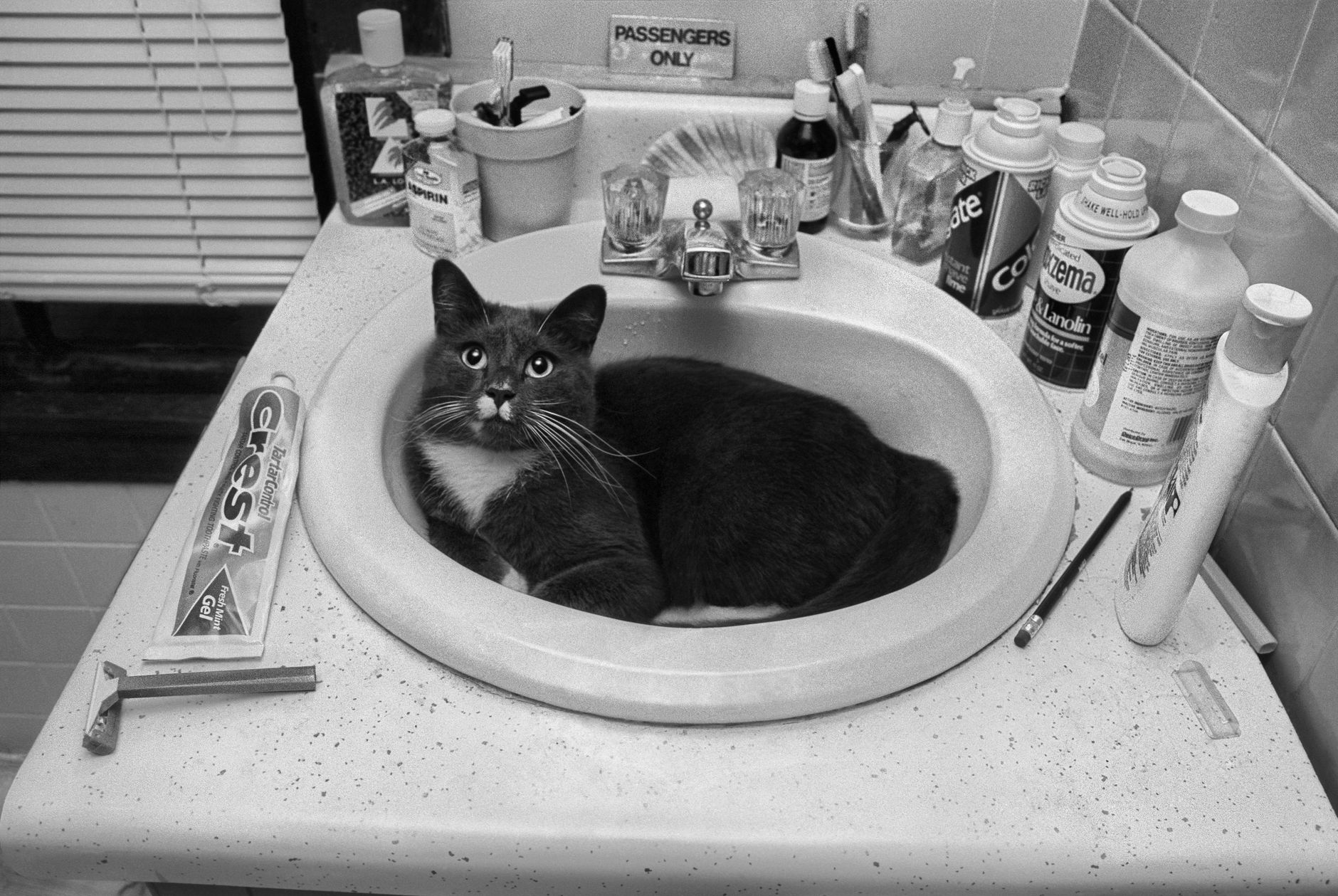
The bathroom is where the full-strength product is open, and where spills happen. The poison center review lists a cat being splashed during a medication spill among the common ways cats were exposed. A 2024 report in Veterinary Sciences followed an adult American Shorthair that “accidentally knocked over the solution bottle, thereby spilling it onto its body and licking it.” It reached a hospital a day later and needed hemodialysis; “The cat recovered fully and was discharged on the 11th day of hospitalization.” Cats Protection’s Sarah Merrett adds that even “drops or accidental spills on to a cat’s coat, have caused life-threatening illness.”
Drips you never see can matter too. The AAD says that “If this medication drips onto a countertop, the floor, or any other surface, it can make your pet sick if they lick the surface, or they get the medication on their paws.” A cat that walks across a counter and then washes its feet can swallow some of whatever the counter held.
Habits for the bathroom:
- Keep the cat out for the whole job, not just the application. The AAD’s wording is “Keep your pet out of the room while applying minoxidil and cleaning up,” because “Cats can jump onto a countertop to see what you have, or minoxidil may splash while you’re applying it.”
- Apply standing over the sink, so a stray drop runs toward the drain instead of across the counter.
- Cap the bottle before you put it down; an open bottle on a counter is one swipe of a paw from a spill.
- Wipe the counter and the floor where you stood. The AAD’s method: “To clean surfaces, wash them with soap and water. Then rinse well.” The ASPCA adds: “Clean spills immediately and thoroughly, even if they seem minor.”
- If any of a spill reached your cat’s coat or paws, that is an exposure: call your vet or a poison line before you do anything else.
Bins, tissues, cotton swabs and empty bottles
Whatever you use to apply or tidy up keeps the drug on it. The AAD notes that “Pets often become sick when they find something with minoxidil on it, such as a tissue or cotton swab,” and that “Anything with minoxidil on it, including a tissue or empty bottle, can be toxic to your pet.” The Vet Times review lists chewing discarded bottles among reported pet exposures.
Bins matter even more in homes with a dog. In the ASPCA poison center data, “Exploratory behavior (e.g., searching through trash) was the most common dog exposure circumstance,” and a knocked-over bin puts its contents within reach of every animal in the house.
The ASPCA wants used “tissues, towels and applicators/bottles in secured trash receptacles, away from pet access.” The AAD is specific about what secure means: a container “that’s too heavy for your pet to knock over and also has a lid that your pet cannot open.” If you do not have one, its fallback is to “place everything that has minoxidil on it in a plastic bag and immediately take that bag to your outside trash container.” A used tissue left on a nightstand overnight is the opposite of both.
The bottle itself and where you keep it
The labels think about children and fire, not cats. The foam carton tells you to “Keep out of reach of children” and to “Avoid fire, flame, or smoking during and immediately following application,” and the solution carries the line “Flammable: Keep away from fire or flame.” Neither mentions pets.
Reach is the problem. The ASPCA’s instruction is “Store all minoxidil products securely and locked away from any pet access,” and the AAD explains why a high shelf is not enough: “Cats and dogs can open doors, including cabinet doors. Cats instinctively jump and climb.” The FDA’s guidance on storing medicines around pets makes the same point, warning that “kitchen and bathroom counters, shelves, and other high places may not be secure enough,” that a pet “could also knock a tube of medication off a counter or bedside table onto the floor,” and that “medication containers that are child safe may not be pet safe.” The cat in the hemodialysis case above was poisoned by exactly that: a bottle within reach that tipped.
The same storage applies to look-alike products. The ASPCA warns that some hair and beard growth products “can also contain minoxidil-like ingredients that carry risks as well, including Aminexil®, Nanoxidil®, and Neoxyl®, amongst others.” If a bottle in your cabinet promises regrowth, read its ingredient list before treating it as harmless. For the other medicines that share that cabinet, see our guide to human medicine and cats.
A residue checklist, route by route
This table pulls the habits above into one place. It is a summary of what the sources advise, not a tested protocol, and it works best when everyone in the home who uses minoxidil follows it.
| Route | Habit that lowers the risk |
|---|---|
| Hands | Apply behind a closed door; wash with soap for at least 20 seconds before opening it |
| Hands, later in the day | Wash again after touching treated hair and before handling the cat |
| Scalp, hair, beard | No licking, grooming or burrowing; greet with a washed hand, not your head |
| Hat, scarf, hair towel | Launder after use; never leave them where the cat sleeps |
| Pillowcase and bed | Cat off your pillow and bed; change cases often |
| Sofa, armchair, car headrest | Cover or wash the spot your head rests on |
| Counter, sink, floor | Cat out until you finish; wash with soap and water, then rinse |
| Spills | Clean at once, however small; any on the cat means a call |
| Tissues, swabs, empty bottles | Heavy lidded bin, or bag them straight to the outside trash |
| The bottle | Capped and back in a latched cabinet after every use |
If a slip does happen, the call comes before anything else, even when your cat seems perfectly well. Signs, according to the ASPCA, “can develop rapidly or be delayed up to 12 hours.” Have the bottle in your hand when you dial. Pet Poison Helpline asks owners to note “what medication was ingested, how much was consumed, including the strength and quantity, and when the exposure occurred.”
Talking to your prescriber about formulation
Some owners wonder whether a different form of minoxidil would be easier to live with around a cat. That is a fair question to take to whoever prescribed or recommended your treatment. It is not one a cat website can answer, because it involves your own health as much as your cat’s, and every form contains the same drug.
What changes between forms is the route, not the hazard. A dropper solution and a foam leave the drug on your scalp in much the same way, but they differ in ingredients and in how they drip and spill; the minoxidil foam vs liquid page lays them out without calling either one safe. Low-dose tablets prescribed for hair loss put nothing on your scalp but create a new risk in a dropped or stolen pill, and that trade-off is the subject of our oral minoxidil and cats page.
Both major sources leave the door open. The ASPCA suggests that “If there are concerns about possible high exposure risk in a pet household, consider speaking to a medical professional about possible alternative treatment options or medications.” The AAD’s version: “If you are still worried about your pet’s safety, talk with your board-certified dermatologist. Another treatment for regrowing your hair may be an option.”
Go to that appointment with specifics: that you live with a cat, whether it sleeps on your pillow or licks your hair, whether anyone else at home uses minoxidil, and any near-misses you have already had. Those details let your prescriber weigh the choice with you instead of guessing.
Frequently Asked Questions
Can I use Rogaine if my cat sleeps in my bed?
Dermatologists at the AAD tell owners to keep pets off the pillow and the bed during treatment, because the drug spreads from your head to the fabric and then to your cat’s fur. No study has tested a routine that makes shared sleeping safe. If your cat will not give up the bed, ask your veterinarian for ways to change the habit.
Should I wear gloves to apply minoxidil?
None of the labels or pet guidance we read mention gloves for minoxidil. The foam label says to wash your hands well after massaging it in, and the American Academy of Dermatology wants a soap wash lasting 20 seconds or more. If you do use gloves, they carry the drug afterwards and belong in a lidded bin the cat cannot reach.
My partner uses minoxidil, not me. Is my cat still at risk?
Yes. In a 2025 case report, a young cat went into heart failure twice, each time after grooming the hair of a relative on minoxidil treatment, and its vets considered the drug a likely contributor. The routes in this guide apply to whoever in the home uses the product, including their pillow, towels and bin.
Can I use my minoxidil on a bald spot on my cat?
Never. The dermatologists’ own pet guidance rules out using people’s hair-regrowth minoxidil on an animal’s coat. Hair loss in a cat has many causes, and a veterinarian can find the cause and prescribe a treatment made for animals.
Are beard growth products a risk to cats too?
Some can be. The ASPCA warns that products marketed for hair or beard growth may contain minoxidil or minoxidil-like ingredients such as Aminexil, Nanoxidil and Neoxyl. Check the ingredient list and handle any of them with the same routine as minoxidil.
Sources
- Topical Minoxidil Exposures and Toxicoses in Dogs and Cats: 211 Cases (2001-2019) — Journal of the American Animal Hospital Association, 2021
- Minoxidil and Pets: What You Need to Know — ASPCA, February 26, 2026; read October 8, 2026
- Dermatologists caution: Minoxidil can be toxic to cats and dogs — American Academy of Dermatology, last updated 8/17/26; read October 8, 2026
- Hair Loss Drug Can be Deadly to Pets — Pet Poison Helpline (Toxin Tails), August 2023; read October 8, 2026
- Heart failure associated with minoxidil intoxication in a cat — Journal of Veterinary Cardiology, 2025
- A Case Report of Successful Treatment of Minoxidil Toxicosis Using Hemodialysis in a Cat — Veterinary Sciences (MDPI), 2024
- Minoxidil: a comprehensive review — Journal of Dermatological Treatment, 2022
- MENS ROGAINE EXTRA STRENGTH UNSCENTED- minoxidil solution — DailyMed (Kenvue Brands LLC label), label updated September 6, 2024; read October 8, 2026
- MENS ROGAINE MINOXIDIL – UNSCENTED FORMULA- minoxidil aerosol, foam — DailyMed (Kenvue Brands LLC label), label updated November 11, 2024; read October 8, 2026
- Properly Store Medications to Keep Your Pet Safe — U.S. Food and Drug Administration, Center for Veterinary Medicine, content current as of 06/14/2024; read October 8, 2026
- Minoxidil toxicosis in felines — Vet Times, 11 Aug 2026; read October 8, 2026
- Cat poison warning issued over hair loss treatment — Vet Times, 20 May 2026; read October 8, 2026
This article is general information for cat owners, written from the published veterinary literature and poison control guidance listed above. It is not a diagnosis or a treatment plan for your cat. If you think your cat has been exposed to minoxidil or any other medication, contact a veterinarian or an animal poison control center straight away. Rogaine is a registered trademark of its owner; Cat Professor is not affiliated with any drug maker.