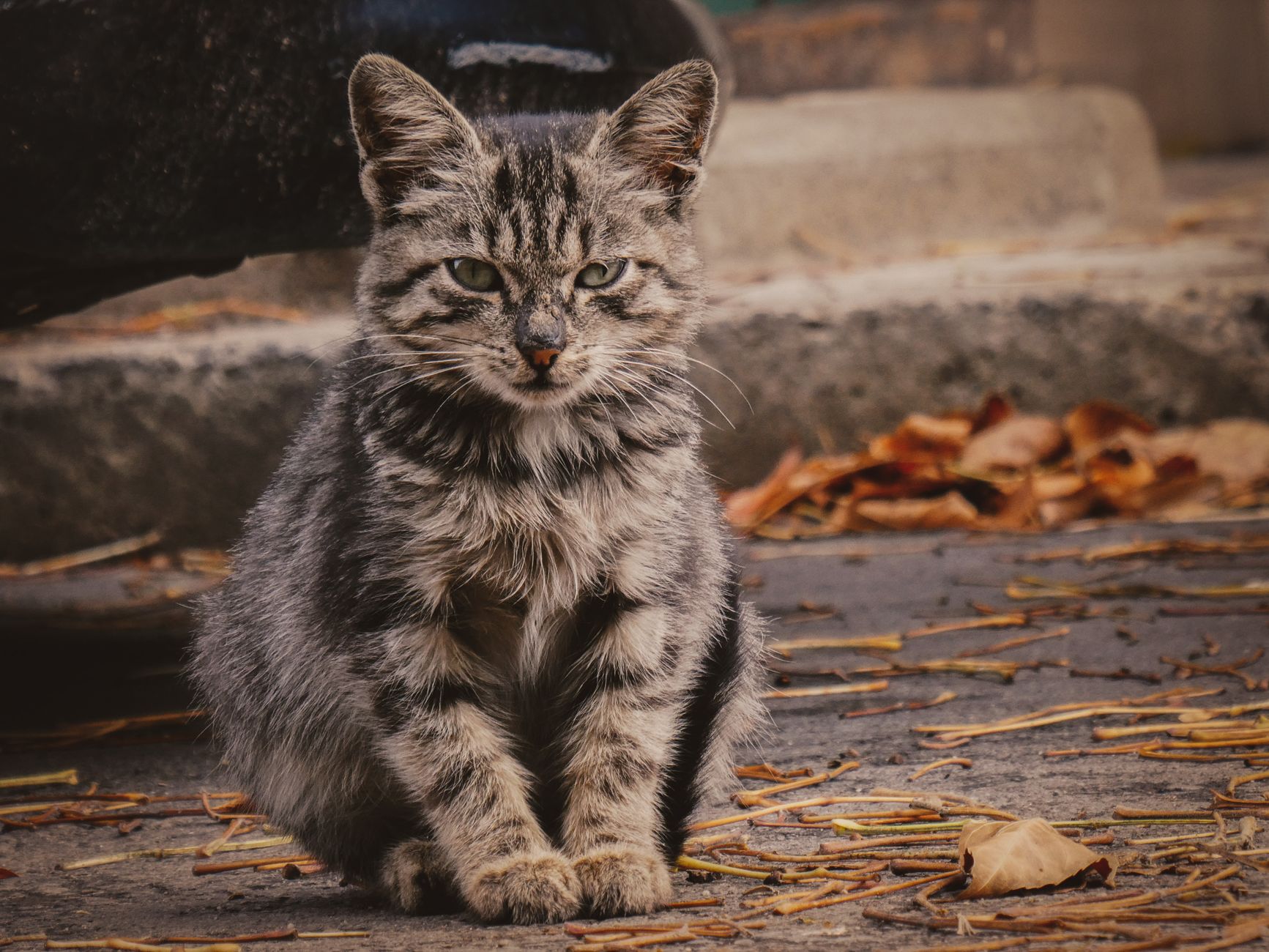
Stray and feral cats get through winter by hunting small rodents, scavenging carrion, and raiding whatever food humans leave behind — and they do it over a much smaller area than they cover in summer. Winter does not make them roam farther for food; it makes them hunt closer to home, mostly at night, with rodents replacing the birds and reptiles that carried them through warmer months. That survival strategy works, but it works thinly. Cats living without a caregiver tend to sit at the lean edge of healthy body condition, with almost no fat reserve to absorb a bad week — which is why the winter advice from community-cat organizations is about calories and liquid water, not shelter alone.
Table of Contents
- Why a cat's diet is so hard to starve out
- What winter actually changes about the menu
- Cats hunt a smaller circle in winter, not a bigger one
- How much do strays rely on human food?
- Where unassisted foraging runs out
- What a caregiver should change when it turns cold
- Frequently Asked Questions
Why a cat's diet is so hard to starve out
A cat's advantage in a lean season is that it is not a specialist. A global synthesis of free-ranging domestic cat diet published by Lepczyk and colleagues in Nature Communications recorded 2,084 species eaten worldwide, about 90% of them birds, reptiles and mammals, and 97% of prey species under 5 kg adult body mass. The practical meaning of that number is substitution.
A cat that loses access to one food type in November does not go hungry waiting for it to return; it switches to whatever is still moving and still small enough to kill. "Feral" here means a cat born outside or long since gone unsocialized to people, surviving without an owner. "Stray" usually means a cat that was owned and is now loose. Both hunt, but a long-term feral cat has had more practice at it.
What winter actually changes about the menu
Winter removes the easy warm-season prey. Scat analysis of feral cats on Hawke's Bay farmland in New Zealand, published by Langham in the New Zealand Journal of Zoology, found mice significantly more frequent in winter scats and possum remains almost entirely in winter, while birds dominated spring and summer. Scavenging is the second half of the answer, and it is documented rather than anecdotal.
Molsher's study of feral cats in open forest in New South Wales, held at the University of Sydney, found carrion — mostly eastern grey kangaroo and sheep — an important secondary food at 21.5% frequency of occurrence, particularly in winter and spring. Rodents also stay reachable under snow. In the subnivean zone beneath the snowpack, temperatures hold near 32°F (0°C) and voles stay active in tunnels, foraging and nesting through the season, according to the Idaho Department of Fish and Game's Wildlife Express. Hearing-based hunters, cats included, keep working that layer.
Cats hunt a smaller circle in winter, not a bigger one
The intuitive guess — hungry cat, wider search — is backwards. GPS tracking of 23 free-roaming cats in Cape Town across 2010-2011, reported by the University of Cape Town, recorded mean home ranges of about 3.00 hectares in summer against about 0.87 hectares in winter, with a maximum excursion of 849 m in summer versus 298 m in winter. Shrinking the range conserves energy, which is the scarce resource in cold weather.
Travel costs calories; so does staying warm. A cat that concentrates on a reliable patch within a few hundred metres of shelter spends less and loses less heat. That has a direct consequence for anyone who feeds community cats: a feeding station placed far from where the cats actually shelter may simply go unvisited in January, even if the same cats used that area in July.
How much do strays rely on human food?
It depends heavily on how built up the neighbourhood is. Research along a rural-to-urban gradient in Poland, published in Urban Ecosystems, found anthropogenic food — scraps, waste, provisioned food — an important part of urban cats' diet, with its significance falling as urbanisation decreased, while predation rate and prey diversity were both highest in rural areas. So an alley cat behind a row of restaurants and a barn cat ten miles out are solving different problems with different tools.
The city cat leans on human food and hunts less; the rural cat hunts more and finds fewer handouts. Being fed does not switch hunting off either. DNA sequencing of scat from five Trap-Neuter-Return colonies in Staten Island parks, published by Plimpton and colleagues in the Journal of Urban Ecology, detected 3 non-native prey taxa — including *Mus* mice, *Sturnus* starlings and Columbidae pigeons — alongside 13 native prey taxa, in cats receiving daily caregiver meals.
Where unassisted foraging runs out
Working for food costs a cat something measurable. Radio-telemetry of free-roaming cats in central Illinois by Horn and colleagues, in the *Journal of Wildlife Management*, found unowned cats were more nocturnal and more active overall than owned cats, with one feral male ranging over 547 hectares (1,351 acres). The body-condition data shows what that activity buys.
Scott, Levy and Crawford examined 103 feral cats presented for neutering, in the *Journal of Applied Animal Welfare Science*, and found an average body condition score of 4 on a 1-9 scale, where 1 is emaciated, with small falciform fat pad depth and area. Weight, score and fat pads all rose a year later once caregivers were feeding them. Read plainly: unfed free-living cats are usually not starving, but they are carrying almost no reserve. A hard freeze, an injury, or a fortnight of frozen water is not absorbed the way a well-fed house cat would absorb it.
What a caregiver should change when it turns cold
Winter feeding is a different job from summer feeding, and most of the difference is calories and unfrozen water. ASPCA Pro's winter community-cat guidance tells caregivers to increase portions because cats burn more energy staying warm, use an insulated feeding station, site it away from sleeping and elimination areas, and put out fresh water twice daily so it does not freeze. If you are starting fresh with a colony this winter, pick the spot the cats are already sheltering in and feed there, not where it is most convenient for you to park.
- Increase portion size rather than adding more feeding times — the goal is more calories, not more trips.
- Keep the feeding station insulated and sheltered, but separate from where cats sleep and where they eliminate.
- Refresh water twice a day; a frozen bowl is the same as no bowl.
- Place the station close to known shelter, because winter home ranges contract to a fraction of their summer size.
- Expect hunting to continue regardless — fed colony cats in the Staten Island study were still taking mice, starlings and pigeons.
Frequently Asked Questions
Do stray cats stop hunting if someone feeds them daily?
No. DNA analysis of scat from five fed Trap-Neuter-Return colonies in Staten Island parks still found 3 non-native and 13 native prey taxa, including mice, starlings and pigeons.
Can cats still catch rodents when there is snow on the ground?
Yes. The Idaho Department of Fish and Game notes that under the snowpack, temperatures hold near 32°F (0°C) and voles stay active in tunnels, so hearing-based predators keep hunting them.
Are urban strays better fed than rural ones?
They eat differently rather than better. The Polish gradient study found human-sourced food most important in urban areas, while rural cats showed the highest predation rates and the widest range of prey.