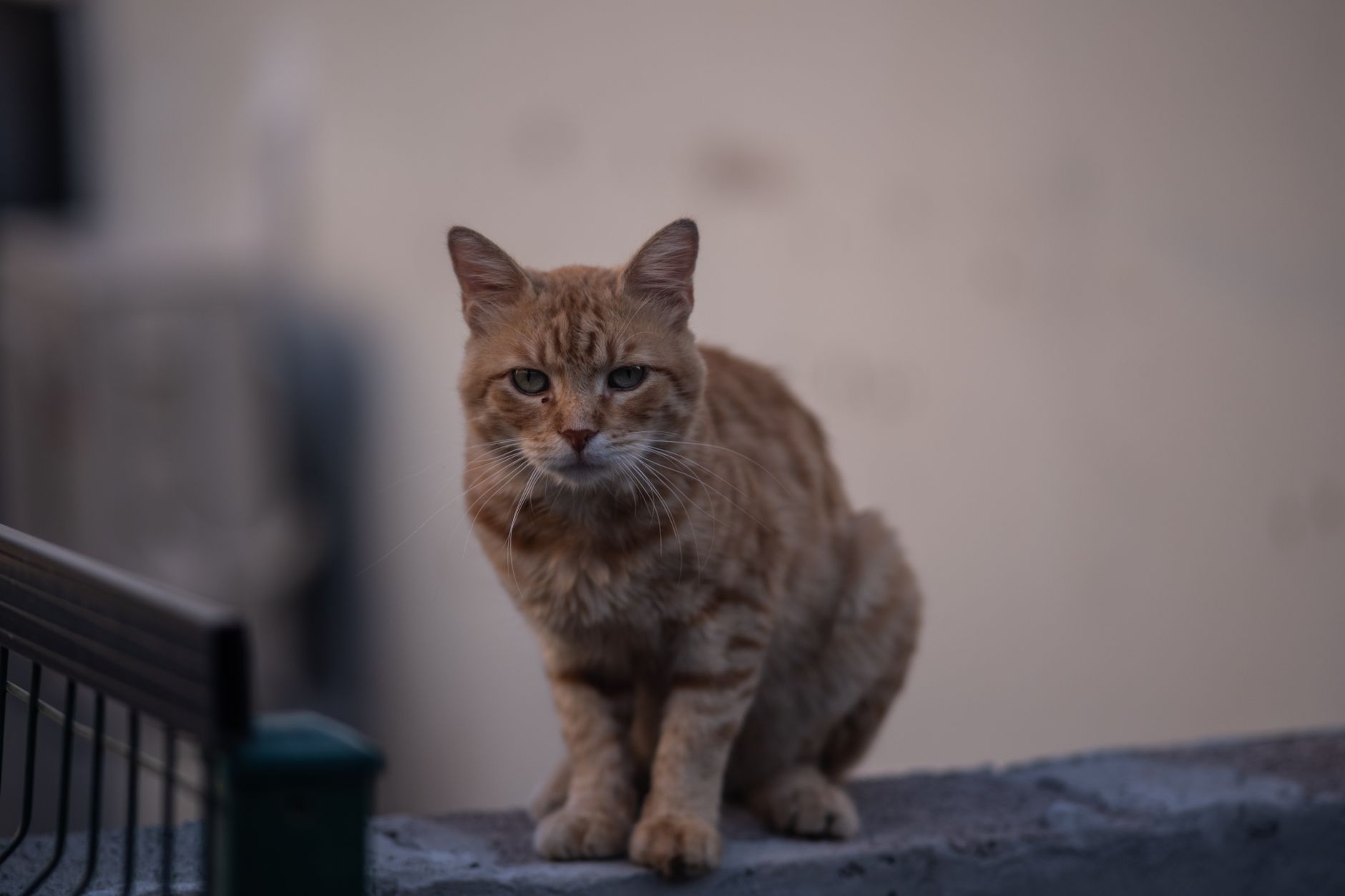
Senior stray cats survive winter on a combination of learned shelter-finding, a caretaker's dry insulated box, and more food than they eat in summer — and most of them do it while hiding pain. A cat over 10 living outdoors is almost certainly carrying arthritis, and often kidney disease, so the ordinary winter math of body heat versus cold works against it harder than it does against a young colony cat. The practical answer is that survival depends less on the cat's toughness than on three things a person controls: a small, elevated, straw-bedded shelter; water that is not frozen; and a calorie increase that offsets the energy burned staying warm. The sections below cover what "senior" means for a stray, what is likely wrong with its body, and what to change before the first hard freeze.
Table of Contents
- What "senior" means for a cat nobody has examined
- Arthritis is the hidden cost of every jump
- Kidney disease makes frozen water an emergency
- Build the shelter small, dry, and low
- Feed more in winter, and watch the weight line
- Winter hazards that kill the cat you were protecting
- Frequently Asked Questions
What "senior" means for a cat nobody has examined
The 2021 AAHA/AAFP Feline Life Stage Guidelines put "senior" at over 10 years old, with 7–10 classed as mature adult. The same guidelines note that a cat past 10 in excellent condition can reasonably be managed as a mature adult, so age alone is not a diagnosis. For a stray, you usually have no birth date.
Caretakers estimate from a short list of visible signs: thinning or coarsening coat, visible spine and hip bones despite eating, worn or missing teeth, cloudiness in the eyes, a stiff or shortened stride, and a reluctance to jump onto surfaces the cat used to clear. An old stray is also a statistical outlier. A trap-neuter-return colony analysis by McCarthy, Levine and Reed, reported by PetMD, found median survival around 267 days for intact adult males and 593 days for intact adult females. A cat that reaches 10 outdoors is a survivor of hard selection, not a typical case — which is worth knowing before you assume it will simply keep coping.
Arthritis is the hidden cost of every jump
Lascelles and colleagues radiographed 100 randomly selected cats up to 20 years old and found degenerative joint disease in 92%; a separate retrospective of cats over 12 found radiographic DJD in 90%, though only four records mentioned it, as summarized by dvm360. Nearly every senior outdoor cat is climbing fences, crouching into shelters and landing off walls on damaged joints. The limitation matters as much as the number.
Radiographic arthritis correlates poorly with what you can see: in one referral-hospital study 33.9% of cats had radiographic DJD while only 16.5% showed clinical signs, and in another only about a third of radiographically affected cats showed clinical evidence, per dvm360's review of recognition and treatment. A stray that looks merely slow may be in pain no caretaker can detect. That changes shelter design from a comfort question into an access question. A box the cat has to leap to reach, or squeeze down into, may go unused all winter while the cat sleeps somewhere wet.
Kidney disease makes frozen water an emergency
Marino and colleagues (2014), sampling a feline-only practice, reported chronic kidney disease prevalence above 40% in cats aged 5–15 and about 80% in cats over 15; IDEXX data put it at 67% in cats over 18. Chronic kidney disease means the kidneys can no longer concentrate urine, so the cat loses water it cannot replace by conserving. For a healthy young cat, a water bowl frozen for a day is a discomfort.
For a senior with CKD it is a path to dehydration, because that cat has to keep drinking to break even. Snow is not a substitute — eating it costs body heat and delivers very little water. Alley Cat Allies advises checking water repeatedly in freezing weather because it freezes quickly, and notes that insulated bowls delay freezing, in its arctic blast guidance. Two or three refills a day during a cold snap is the realistic standard, not one.
Build the shelter small, dry, and low
Geometry beats size. ASPCApro and Bideawee advise a small, insulated, elevated box with a small entrance, because the cat's own body heat is the only heat source — a large shelter stays as cold inside as the outside air, and a wide opening lets the cold straight in. ASPCApro's winter shelter FAQs covers the build.
Bedding is where most well-meant shelters fail. Alley Cat Allies instructs caretakers to use straw, not hay, blankets or towels: straw repels moisture and keeps the interior dry, while the others soak it up and chill the cat, per its winter weather tips for community cats. A damp blanket is worse than bare floor. Adjustments specific to an arthritic senior:.
- Keep the entrance at ground level or add a short ramp instead of a step up.
- Elevate the floor off cold concrete, but only a few inches — not a jump.
- Give the cat a second shelter if the colony has younger cats; a stiff senior loses competition for the warm spot.
- Set the shelter out of prevailing wind, with the entrance facing away from it.
- Weight the shelter with bricks before a strong storm so it isn't blown away, as Alley Cat Allies advises.
Feed more in winter, and watch the weight line
Cornell's Feline Health Center states that cats burn more calories staying warm in winter, so feeding more than in warm months prevents weight loss; shivering alone consumes substantial energy, according to its cold weather tips. Stack that on a senior already losing muscle to kidney disease or bad teeth and winter underfeeding compounds the loss fast.
A cat with worn or painful teeth may also refuse dry kibble it managed in September, so wet food — served in smaller, more frequent portions so it does not freeze solid — is often the difference between eating and picking. Weigh the practical limits honestly: you cannot dose a stray's arthritis, you cannot fluid-therapy a colony cat, and a cat that has lived outdoors for a decade may not be trappable without weeks of work. What you can change is dryness, calories, liquid water, and the height of every surface it has to reach.
Winter hazards that kill the cat you were protecting
Outdoor cats shelter under and inside car engine compartments for the residual heat, which is why the ASPCA tells drivers to bang loudly on the hood before starting the engine. A senior that is slow to move has less margin here than a young cat. The ASPCA also warns that antifreeze is lethal and recommends propylene-glycol products in its cold weather safety guidance, which gives Animal Poison Control at (888) 426-4435.
Ethylene glycol tastes sweet, pools visibly in driveways, and takes very little to cause fatal kidney injury — in a cat whose kidneys are already failing, less still. Salt and chemical de-icers are the quieter hazard: they irritate paw pads and get swallowed during grooming. Clear a shoveled path to the shelter and the feeding station rather than salting it, and rinse the area if a neighbour has salted heavily.
Frequently Asked Questions
Can an old stray just be brought indoors for the winter instead?
Sometimes, and it is the better outcome when the cat tolerates it. A long-term outdoor cat may panic in a house, so start with a confined quiet room and expect a slow adjustment; if it does not settle, a dry shelter outdoors beats a terrified cat indoors.
How cold is too cold for a senior cat with shelter?
There is no single temperature. Wind and wet matter more than the number — a damp 35°F with wind strips heat faster than a dry 20°F. Judge by whether the cat's bedding is dry and whether the cat is using the shelter at all.
Does a heated bed or heating pad help?
It can, but only outdoor-rated heated pads designed for pets, and only where the cord is protected and the cat can move off the heat. An unheated small shelter with deep dry straw works without any electrical risk, which is why it remains the standard recommendation.
Should a senior stray still be trapped for TNR or a vet check?
Yes if it is unaltered or visibly declining, but time it outside a hard freeze and arrange recovery space first. Recovery from anesthesia in freezing weather is a real risk, so the trap and the warm recovery location need to be lined up before you set anything.