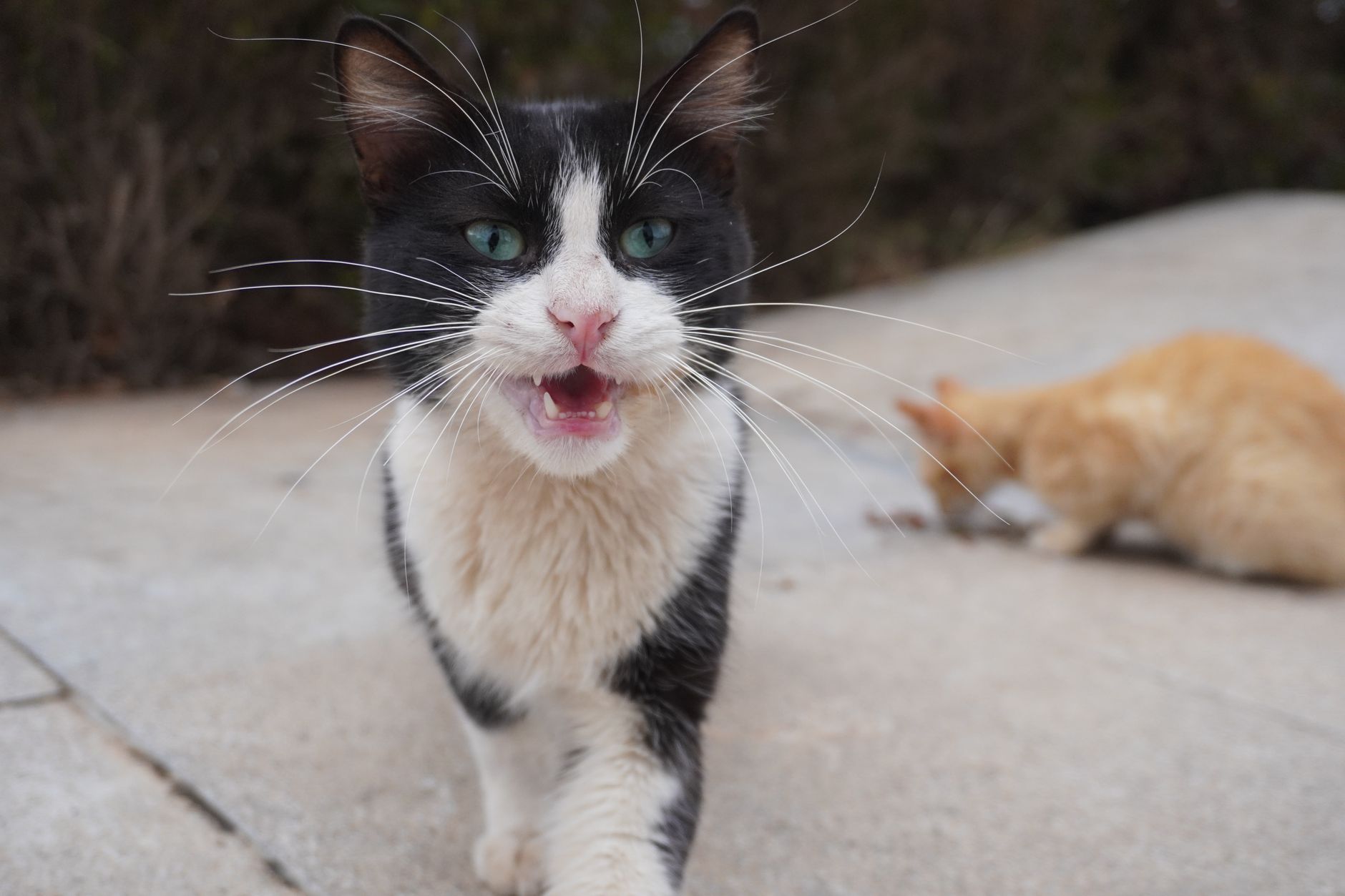
Stray cats gather near restaurants and dumpsters because that is where the food is, and it is far easier food than hunting. Commercial food waste is dense, predictable, and renewed daily, so a single bin can support several cats in a space one cat would otherwise need to itself.
The evidence for this is direct. When researchers examine what free-roaming cats have actually eaten near commercial premises and rubbish sites, refuse dominates the stomach contents, and wildlife does not. That single fact explains most of what people observe behind a restaurant: the numbers, the tolerance between cats, the fixed schedule, and why the group does not disperse on its own.
Table of Contents
- What the cats are actually eating
- Why many cats tolerate one bin
- Are they there for the rats?
- What predicts how many cats appear
- What to do about a colony at your bins
- Where the evidence has limits
- Frequently Asked Questions
What the cats are actually eating
A study of free-roaming cats in Perth, Western Australia, published in the *Journal of Urban Ecology*, measured the contents of cats' gastrointestinal tracts by mass. For cats collected at commercial locations, refuse made up 57% of total content mass, and 55% at rural rubbish tips. Urban cats away from those sites were at 29%, and peri-urban cats at just 10%. The same pattern shows up in a very different setting.
U.S. Geological Survey researchers used stable-isotope analysis of cat hair in the Florida Keys and found that, at the population level, cats on both islands ate mostly anthropogenic food — over 80% of the diet. Densities were roughly 4 cats per square kilometre on Big Pine Key and 1 per square kilometre on Key Largo. "Anthropogenic food" here means anything that reaches the cat because of people: scraps, discarded prep waste, spilled product, and deliberate feeding. A dumpster behind a kitchen is the concentrated version of all of it.
Why many cats tolerate one bin
Cats are not naturally communal foragers, so a crowd of them in one alley looks odd. The explanation is spatial. A meta-analysis of feral cat studies in the *Journal of Mammalogy* found home-range size scaled negatively with population density — the more cats in an area, the smaller the patch each one uses. An urban South African study in *Urban Ecosystems* identified supplemental resources as the primary driver of home ranges, with feeding sites falling inside individual cats' core areas.
When calories are clumped at one point rather than spread across a neighbourhood, a cat does not need to patrol. Several cats can therefore overlap on the same point without the constant conflict that competing over a wide hunting territory would cause. This is why the group holds its shape. The bin is not a place the cats pass through; it sits at the centre of where each of them lives.
Are they there for the rats?
Usually not, and this is the explanation most often offered and least supported. Researchers at a Brooklyn waste-recycling facility recorded cats and rats on video between 27 December 2017 and 28 May 2018. Across 306 videos, they logged only 20 stalking events and 3 predation attempts, and the rats shifted their movement patterns rather than declining in number.
A city rat is large, defended, and not worth the risk when an open bin is a few metres away. Cats take the cheaper option, which means a colony at a dumpster is a sign of available waste, not of rodent control in progress. The practical consequence matters for anyone managing a property: adding cats will not clear rats, and feeding cats to keep them on site adds a second animal to manage alongside the first.
What predicts how many cats appear
Unowned cat numbers track human conditions rather than available wildlife. A model built on 162 sites across five English urban areas, published in *Scientific Reports* by McDonald and Skillings in October 2021, found that deprivation explained about 31% of the variation in unowned cat abundance, and human population density about 7%, with 100% posterior probability that abundance rises with both. The same work estimated 247,429 unowned cats across UK urban areas — an average of 9.3 cats per square kilometre, but a range from 1.9 to 57 depending on location, according to the University of Bristol and Cats Protection summary.
Gathering points are local hotspots, not an even spread. Deliberate feeding is part of the picture too. A Seoul study published in *PeerJ* in June 2018 selected six districts specifically for their differing levels of supplemental feeding and cat-caretaker activity, estimating cat density by mark-recapture, to test how feeding relates to host density and density-dependent disease.
What to do about a colony at your bins
The fix addresses two things at once: the food source and the breeding. The New Jersey Department of Health states plainly that free-roaming cats that are fed and not sterilized will breed and increase, that spay/neuter stabilizes a colony, and that caregivers are responsible for resolving nuisance or public-health problems with animal control.
Municipal codes tend to target the container rather than the cat. Inman, Kansas requires garbage cans left outdoors to be tightly secured with proper lids to prevent stray cats or other animals from entering, and Nassau County, New York bars putting food out where it is accessible to rodents. Steps that follow from the evidence:.
- Secure every lid and repair split bins; an unsealed container is the attractant, not the cats.
- Move food-waste storage inside or into a closed enclosure where the building allows it, and tighten collection frequency.
- Clear spilled prep waste and grease from the loading area daily, since residue keeps cats returning after bins are sealed.
- Contact a local trap-neuter-return group or animal control rather than relocating cats yourself; an unsterilized colony replaces its own numbers.
- If anyone on site is feeding the cats, agree on a single managed feeding point away from the bins, paired with sterilization, instead of scattered scraps.
Where the evidence has limits
The feeding-and-density link is strong but not universal. A Texas exurban study found that neither season nor supplemental feeding had a significant effect on cat population density, so the local setting changes the outcome. A 2025 study in *Urban Ecosystems* also reported results contradicting the positive relationship between cat and human density in some greenspace neighbourhoods.
Habitat, housing type, and surrounding land use all mediate the effect. The most reliable reading is the narrow one: at a specific commercial site, the refuse figures show the bin is a real food source, and the home-range work shows why sealing it changes how cats use the area. How many cats a wider district holds depends on local conditions that no single study settles.
Frequently Asked Questions
Will removing the cats solve the problem?
Not on its own. New Jersey's health department notes that fed, unsterilized cats breed and increase, so an unsecured food source refills with new cats. Sealing bins and sterilizing the existing colony is what changes the trend.
Do these cats still hunt wildlife?
Some do, but the Perth gastrointestinal-tract data shows refuse made up the majority of content mass at commercial sites and rubbish tips, versus 10% for peri-urban cats. Where waste is abundant, it displaces most hunting.
Why do the cats appear at the same time each day?
Because the resource is scheduled — prep waste, closing clear-out, or a regular feeder. The South African research found feeding sites sit inside cats' core home ranges, so the cats are already nearby and waiting.