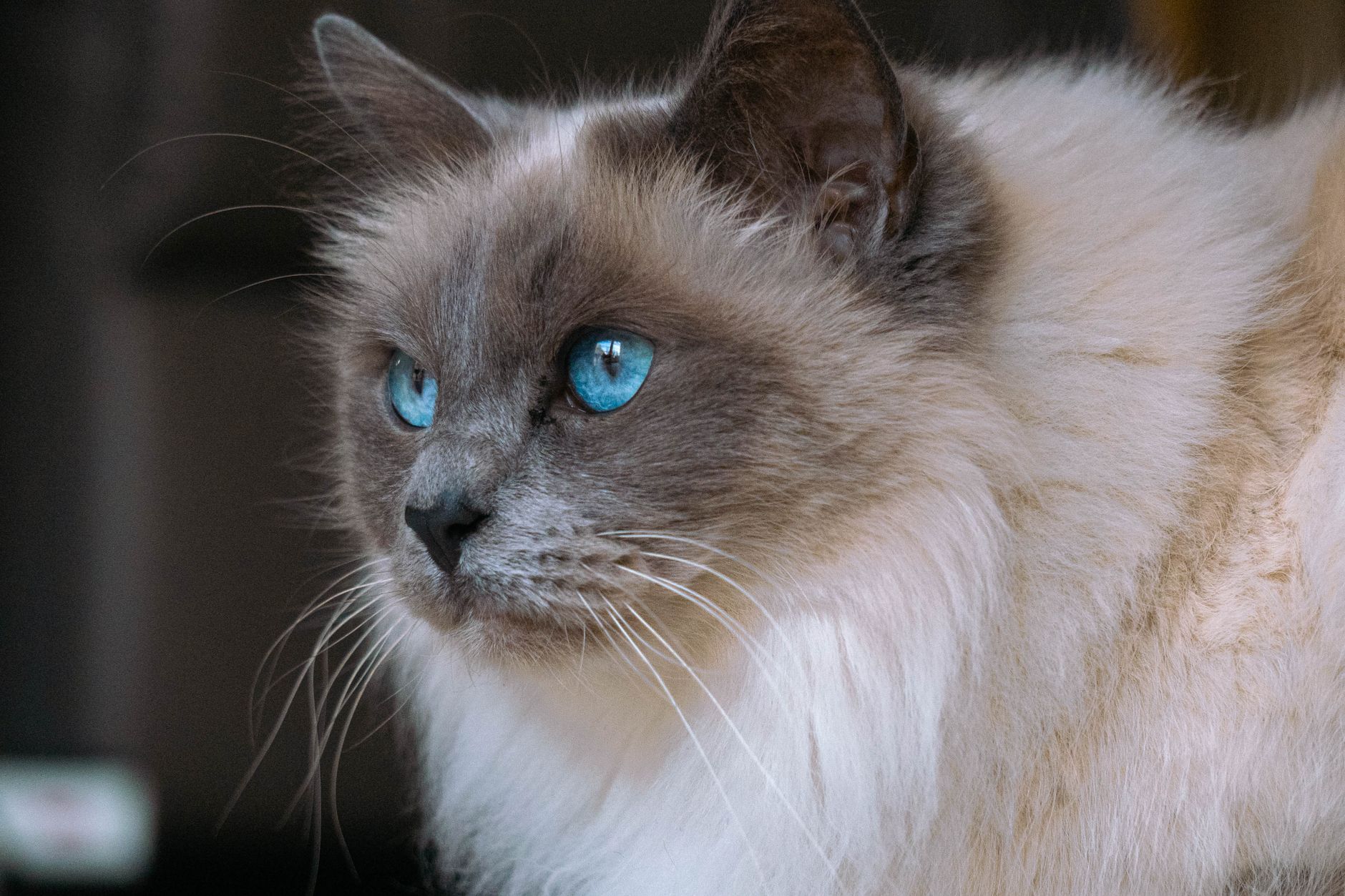
Ragdoll kittens are famous for their floppy, relaxed body structure and tendency to go limp when picked up—a trait that carries over into their sleeping habits in remarkably entertaining ways. These young cats contort themselves into positions that seem physically impossible, draping over furniture edges, sprawling across laps with limbs extended in odd angles, and tucking themselves into spaces far too small for their bodies. A young Ragdoll might be found completely flattened against a tile floor in the kitchen, or folded in half inside a shallow cardboard box, sleeping deeply despite what would look deeply uncomfortable to human standards.
The peculiar sleep positions are not random antics but a combination of Ragdoll breed genetics, normal kitten development, and individual personality. Their naturally relaxed muscle tone and social bonding instinct drive them to sleep in vulnerable positions and unusual locations, often as close as possible to their human companions. Unlike more alert breeds, Ragdolls seem genuinely unbothered by being in exposed or awkward positions, which is why owners frequently find these kittens in comical poses throughout the day. Understanding why Ragdoll kittens sleep the way they do helps owners appreciate this behavior as normal and even endearing, while also recognizing when sleep patterns might signal a health concern.
Table of Contents
- Why Do Ragdoll Kittens Sleep in Such Hilarious and Awkward Positions?
- The Range of Adorable Sleeping Poses Ragdoll Kittens Adopt
- How Kitten Development Influences Sleep Behavior
- Creating an Environment That Encourages Safe Sleep
- Health Considerations Related to Sleep and Body Position
- The Social Aspect of Ragdoll Kitten Sleep Behavior
- When Sleep Position or Frequency Changes Signal Problems
Why Do Ragdoll Kittens Sleep in Such Hilarious and Awkward Positions?
The Ragdoll breed was developed specifically to have a docile, relaxed temperament and minimal muscle tension. This genetic tendency makes Ragdoll kittens significantly more likely than other breeds to collapse into boneless heaps when they rest. Their muscles are naturally less taut, which means they can arrange their bodies in ways that would cause discomfort or fatigue in more muscular breeds. A Ragdoll kitten sleeping across your lap might have one paw dangling off the edge, its head tilted back at an angle, and its hindquarters twisted—yet it sleeps peacefully because its muscle structure accommodates this easily. Additionally, Ragdoll kittens are extremely social animals that want to be near people.
They often choose sleeping spots based on proximity to humans rather than ergonomic comfort. This means a kitten might sleep on a kitchen tile beside your feet because it wants to be near you, even though a soft bed in another room would be more comfortable. The combination of wanting to be close and having a relaxed body type creates the iconic Ragdoll kitten look: a limp, draped form positioned as near as possible to whatever family member is currently present. Kittens in general are still developing their muscle control and coordination, which makes all young cats sleep in random positions. However, Ragdoll kittens take this even further because of their breed traits. A Maine Coon kitten might nap in awkward positions, but a Ragdoll kitten in the same situation will look nearly boneless by comparison.
The Range of Adorable Sleeping Poses Ragdoll Kittens Adopt
ragdoll kittens display a remarkable variety of sleep positions throughout the day. The “flat pancake” is common, where the kitten spreads its entire body flat against a cool surface like tile flooring or hardwood, with limbs extended outward. Another frequent pose is the “loaf,” where the kitten tucks its front paws beneath its body while its rear legs stick out straight behind it, creating an unusual, lopsided silhouette. The “upside-down sprawl” involves the kitten lying on its back with its hind legs splayed and its front paws dangling over its face, sometimes rolling slightly to one side.
Some Ragdoll kittens develop the “drape,” where they position themselves across a human’s lap, over a chair back, or along a sofa arm in such a way that their body weight distributes unevenly, with their head hanging off one edge and their hindquarters off the other. This pose looks uncomfortable but is a signature Ragdoll move. The “pretzel” involves the kitten curling into a tight ball but arranging its limbs in a twisted configuration that seems to defy basic skeletal structure. It’s important to note that while these poses are normal for Ragdolls, an excessively limp kitten or one that cannot move normally when awake could indicate a neurological or muscular problem. Extreme floppiness combined with difficulty walking, jumping, or maintaining balance warrants a veterinary visit.
How Kitten Development Influences Sleep Behavior
Ragdoll kittens go through distinct developmental stages that affect how and where they sleep. During the very early weeks (4 to 8 weeks old), kittens are still dependent on their mother and siblings for warmth and security. They sleep in clusters, piled on top of each other. When separated from littermates and placed in a home, a young kitten may seek human companionship as a replacement for that security, which is why Ragdolls in particular gravitate toward sleeping near their owners. As kittens mature from 8 weeks to 4 months old, their sleep patterns begin to consolidate.
They still sleep 16 to 22 hours per day (compared to adult cats’ typical 12 to 16 hours), but the frequency of naps shifts. Younger kittens take many short naps interspersed throughout the day and night, while slightly older kittens begin taking longer stretches of sleep. During this development, Ragdoll kittens often exhibit the most exaggerated and entertaining sleep positions because their bodies are rapidly changing in size and their muscles are not yet fully developed. The “cute phase” of Ragdoll kitten sleep is typically most pronounced between 8 weeks and 6 months of age. After this period, as the kitten matures and its muscles develop more tone, it may still sleep in odd positions due to breed temperament, but the boneless quality becomes somewhat less extreme. By the time a Ragdoll reaches adulthood, it will retain its relaxed nature, but its sleeping poses will be somewhat less dramatically floppy than during the kitten stage.
Creating an Environment That Encourages Safe Sleep
While Ragdoll kittens will sleep almost anywhere, providing appropriate sleeping spaces reduces the risk of injury and supports healthy rest. Soft, cushioned beds placed in quiet, low-traffic areas encourage kittens to sleep deeply without interruption. Many owners find that Ragdoll kittens prefer elevated surfaces like cat trees, shelves, or furniture, where they can observe their surroundings while resting. However, kittens that are too young or uncoordinated should not have access to heights from which they could fall and injure themselves. Keeping the kitten’s environment at a comfortable temperature matters significantly. Kittens lose body heat quickly and seek warm spots.
If your home is cool, a kitten might sleep in a sunny windowsill or on a heating pad set to low temperature. Conversely, if the environment is too warm, a kitten might adopt the flat pancake position directly on cool tile or hardwood to release excess body heat. Providing options—soft beds, cool surfaces, elevated spots, and heated pads—allows your Ragdoll kitten to self-regulate and find the best sleeping position for its current needs. The trade-off with Ragdoll kittens is that their social bonding means they often want to sleep on or near you, which can disrupt your own sleep. Many owners choose to establish a sleeping arrangement (a bed in the bedroom but not on the bed, or a cat tree nearby) that allows the kitten proximity without occupying the human’s sleeping space. Ragdolls respect boundaries more readily than some breeds, so training a kitten to sleep in a designated area is typically more successful than with more independent breeds.
Health Considerations Related to Sleep and Body Position
Excessive sleeping or lethargy beyond the normal 16-22 hours per day for kittens can signal illness, pain, or developmental problems. A Ragdoll kitten that sleeps constantly, seems unwilling to wake, or appears unresponsive during waking hours needs veterinary evaluation. Similarly, a kitten that cannot maintain comfortable positions or seems to struggle when changing positions might have joint problems, neurological issues, or pain that requires diagnosis. The floppiness characteristic of Ragdolls should be voluntary—the kitten should be able to move normally, jump, and run without difficulty when awake.
If a kitten is so limp that it cannot coordinate its movements or seems to drag its rear legs, these are red flags. Some genetic conditions affect Ragdoll kittens, including hypertrophic cardiomyopathy (a heart condition) and polycystic kidney disease. While these conditions are not directly related to sleep posture, a kitten with underlying health problems may show changes in sleep patterns or energy levels. Responsible breeders test for these conditions before breeding, but acquiring a kitten from a reputable source is important.
The Social Aspect of Ragdoll Kitten Sleep Behavior
Ragdoll kittens’ preference for sleeping near people is not accidental. The breed was developed with extreme focus on human bonding and social temperament. Unlike cats that view humans as caretakers but not necessarily as family, Ragdoll kittens genuinely want proximity to people. This often manifests as sleeping on a human’s lap, curled against a person’s leg on the couch, or draped across a pillow close to where a person rests.
Some Ragdoll kittens will follow their owners from room to room and sleep in brief intervals as the person moves throughout the day, settling into a nap whenever the human stops moving. This behavior is distinct from other affectionate breeds. A Ragdoll kitten might literally sleep in the path your feet must traverse to walk through a hallway, unbothered by the risk of being stepped over. The kitten is not testing boundaries or being stubborn—it genuinely prefers sleeping in a location with human foot traffic because it means being near its person.
When Sleep Position or Frequency Changes Signal Problems
Monitoring changes in your Ragdoll kitten’s sleep behavior helps catch health or environmental problems early. If a kitten that normally sleeps in relaxed, sprawled positions suddenly adopts a tight, curled ball sleeping pose consistently, it may indicate pain or discomfort. Similarly, a kitten that was previously social and slept near people but suddenly isolates itself to sleep alone might be ill or stressed. Seasonal changes in sleep patterns are normal.
During colder months, kittens may sleep more in warmed areas of the home. During warm months, they may seek cool surfaces more frequently and appear to sleep in different locations. However, dramatic shifts in sleep duration (sleeping significantly more or much less than the kitten’s normal pattern), difficulty waking, or seeming confusion when awake warrant veterinary attention. Stress from environmental changes, new pets, loud noises, or home disruptions can also alter sleep patterns temporarily. If the behavior persists beyond a few days or worsens, a veterinary visit is appropriate to rule out underlying issues.
- —