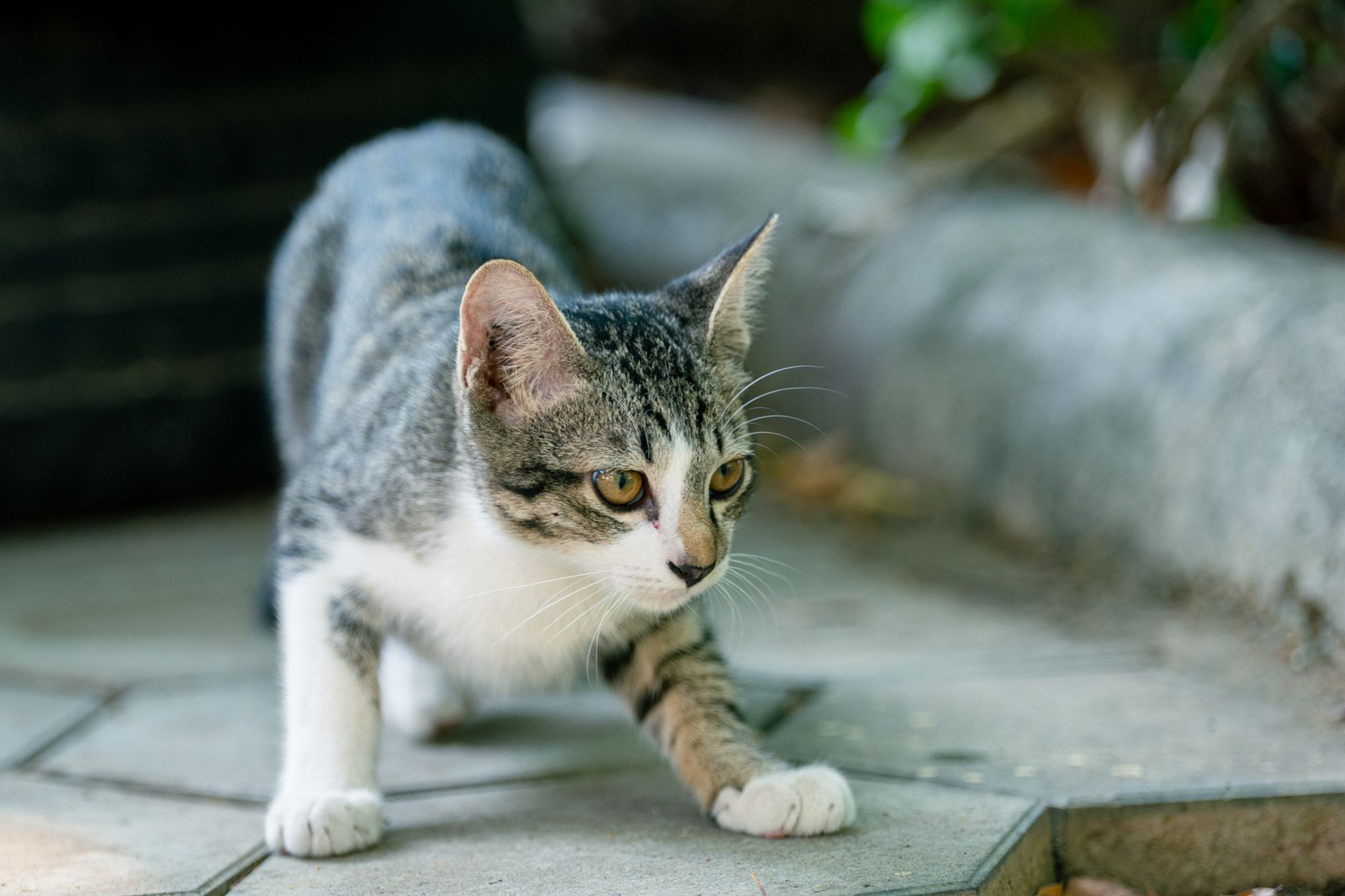
Cat spraying is urine marking — a cat backing up to a vertical surface and releasing a small amount of urine while standing, tail quivering, rather than squatting to empty its bladder. Intact cats spray mostly for reproductive signaling, neutered cats spray for a mix of medical and social reasons, and the fix depends entirely on which one applies. Reproductive hormones drive most spraying in cats that have not been spayed or neutered, but that explanation stops working once a cat is altered, and the condition keeps showing up in multi-cat households, among cats with outdoor access, and alongside underlying illness. The sections below walk through who sprays, what the evidence says causes it, and the concrete steps a cat owner can take.
Table of Contents
- Why intact cats spray
- Why neutered cats still spray
- Is it really my cat causing the stress?
- What to do first
- Multi-cat households need a household-level plan
- Frequently Asked Questions
Why intact cats spray
In cats that have not been spayed or neutered, spraying is a reproductive signal. Male cats mark to warn off rival males, and females in heat use it to advertise that they're receptive, according to Cornell College of Veterinary Medicine behaviorist Dr. Diane Frank.
This is why spaying or neutering resolves spraying for a large share of cats. But it's not a guarantee. A classic study that tracked spraying rates before and after gonadectomy found that about 10% of 134 neutered males and about 5% of 152 spayed females kept spraying frequently later in life, according to research published in the Journal of the American Veterinary Medical Association. Neutering sharply reduces the odds of spraying — it does not eliminate them.
Why neutered cats still spray
Once a cat is altered, the reproductive explanation no longer applies, and the cause becomes harder to pin down. Dr. Frank notes that spraying in neutered cats often relates to anxiety or social tension with other cats in the home rather than reproduction, a different mechanism that calls for a different response. Two risk factors show up consistently in the research: living in a multi-cat household and having outdoor access, alongside age, according to a 2018 review in Frontiers in Veterinary Science.
A cat that can see or smell unfamiliar cats outside, or that's negotiating territory with housemates indoors, is marking to manage that stress — not to attract a mate. Medical disease is also a major contributor that's easy to overlook. A case-control study of cats in multi-cat households found an underlying medical disorder — including renal insufficiency, cystitis, or bladder stones — in about 38.9% of cats that sprayed, compared with about 5.5% of their non-spraying housemates in the same homes, according to a study in the Journal of Feline Medicine and Surgery. That gap is large enough that a medical cause should be the first thing ruled out, not the last.
Is it really my cat causing the stress?
A 2020 study measuring stress hormones in cat urine found that entire households containing a spraying cat had higher overall stress hormone levels than households where cats were only missing the litter box without marking. But the sprayer itself wasn't more stressed than its own housemates, according to the study published in the journal Animals.
That finding changes where to look for a fix. Spraying isn't necessarily a sign that one specific cat is anxious — it can reflect tension across the whole household's social dynamics. Management aimed only at the cat doing the spraying, while ignoring the group's resources and interactions, may miss the actual source of the behavior.
What to do first
The ASPCA's official guidance states the first step for any cat marking with urine is a veterinary exam to rule out medical disease. Spaying or neutering resolves reproduction-driven marking, but it won't fix a medical problem or a purely territorial one — and given how often an underlying disorder turns up in spraying cats, skipping this step risks treating the wrong cause. Veterinary guidelines back this up with a specific intake process.
The 2021 AAHA/AAFP Feline Life Stage Guidelines recommend a detailed history that includes a floor plan marking litter box locations, the total number of cats in the household, and whether the cat has outdoor exposure, according to guidelines from the American Animal Hospital Association and American Association of Feline Practitioners. That history is what distinguishes true marking behavior from a cat simply missing the litter box, which points to a different fix entirely. Once medical causes are addressed or ruled out, the ASPCA recommends a short list of practical changes:.
- Clean sprayed areas with an enzymatic cleaner — ordinary household cleaners leave a residual odor that can prompt the cat to spray the same spot again.
- Block windows or doors so an indoor cat can't see outdoor cats, removing a common trigger for territorial marking.
- Use synthetic feline facial pheromone products in the areas where marking has occurred.
Multi-cat households need a household-level plan
Because risk rises with the number of cats in the home, and because stress hormones run high across the whole household when one cat sprays, a plan that only addresses the individual sprayer is treating half the problem. Each cat benefits from enough separate litter boxes, feeding stations, and resting spots that direct competition is minimized — the kind of resource spacing the AAHA/AAFP intake process is designed to surface by mapping the home's layout and cat count.
Outdoor access compounds the risk in these same households. A resident cat that can see rival cats through a window, on top of competing with housemates indoors, is dealing with two separate triggers for marking at once, which is why the ASPCA's advice to block outdoor sightlines applies even inside crowded multi-cat homes.
Frequently Asked Questions
Does neutering guarantee a cat will stop spraying?
No. Research tracking cats after gonadectomy found about 10% of males and 5% of females kept spraying frequently, according to the JAVMA study.
Could my cat's spraying be caused by a medical problem?
It's common enough to check first. A case-control study found a medical disorder in about 38.9% of spraying cats versus 5.5% of non-spraying housemates, per the Journal of Feline Medicine and Surgery.
If one cat sprays, is that cat the stressed one?
Not necessarily. A 2020 hormone study found elevated stress across the whole household rather than in the sprayer specifically, according to research in Animals.