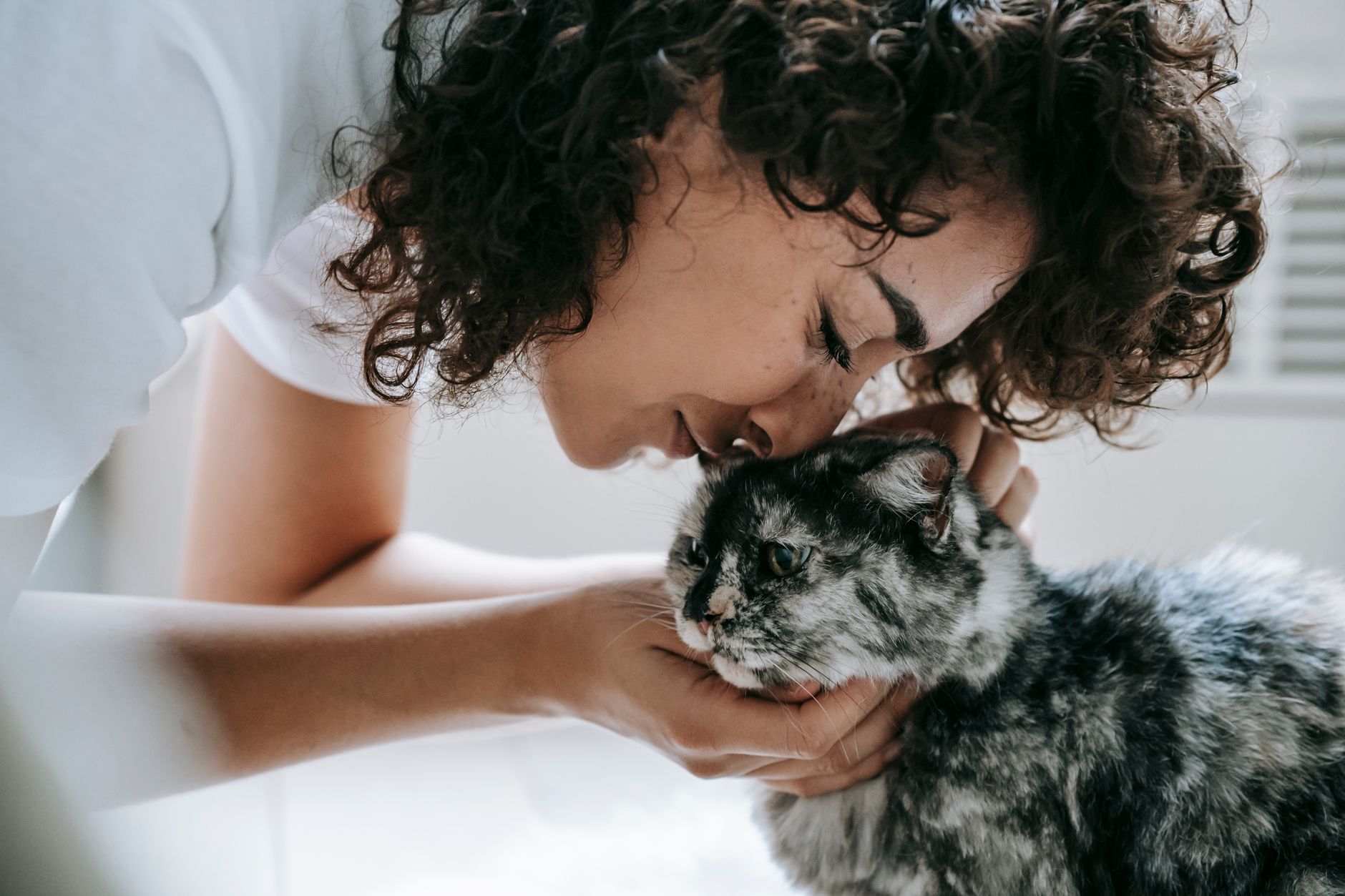
No study, drug label or animal poison control center gives a number of minutes or hours to wait after applying minoxidil before it is safe to touch or cuddle your cat. What the evidence does show is that only about 1.4% of a topical dose passes through human skin, so drying does not make the drug go away: most of it stays on your scalp and hair, and on whatever they touch, until it is washed off.
That turns a timing question into a location question. Your hands can be washed right away. Your scalp, hair or beard stay treated for as long as you use the product. Your pillowcase, hat and sofa headrest quietly collect what rubs off. Each one needs a different answer, and the table further down gives them side by side.
If your cat has licked, eaten or been splashed with minoxidil, call your veterinarian or an emergency animal hospital now, even if your cat seems fine. Two animal poison control centers answer around the clock: the ASPCA Animal Poison Control Center at (888) 426-4435 and Pet Poison Helpline at (855) 764-7661. Both may charge a consultation fee.
Is there a safe wait time after applying minoxidil?
No published figure exists. We looked for one in the veterinary case reports, in the advice pages of the two US animal poison control centers, in the American Academy of Dermatology’s guidance for pet owners and on the Rogaine labels filed with DailyMed (all read October 8, 2026). None of them names a waiting period.
The closest thing to a rule is a single line from the ASPCA: “Ensure topical products dry completely prior to interacting with pets.” That is sensible for the wet liquid on your scalp. The same page, though, warns that “Toxicity has been seen in cats that simply lay on pillows with minoxidil residue and then groom themselves.” Residue on a pillow is, by definition, what is left after the liquid has gone, so dry cannot be read as harmless.
The labels add little. The men’s 5% solution says to “apply one mL with dropper 2 times a day directly onto the scalp in the hair loss area” and gives no drying time, no bedtime advice and no warning about animals. The foam label has one line that matters here, covered in the hands section below.
The one timed case we could find
Pet Poison Helpline published the story of Kratos, a cat whose owner normally kept both cats away while he applied minoxidil. One day off, he sat on the couch instead, and Kratos jumped up and licked his head. In the owner’s words: “It had been 15-20 minutes since I applied the medication, so I didn’t know how dry it was or what the danger could be.”
The helpline recommended a hospital visit, and there Kratos “was placed on intravenous fluids and was kept overnight for intensive care with monitoring of his heart rate, blood pressure and the development of any respiratory changes.” He recovered fully. One cat proves nothing about the right interval, but it does show how the toxicologists treated a lick 15 to 20 minutes after application: as a real exposure needing a hospital, not as something that had dried into safety.
Dry to the touch is not the same as gone
A minoxidil solution is mostly carrier. The 5% solution lists alcohol, propylene glycol, purified water as its inactive ingredients, and the FDA tablet label describes minoxidil itself as “a white to off-white, odorless, crystalline solid that is soluble in water to the extent of approximately 2 mg/mL, is readily soluble in propylene glycol or ethanol.” When the alcohol evaporates and your scalp stops feeling wet, the solid drug has not evaporated with it.
Very little of it soaks in either. A 2022 review in the Journal of Dermatological Treatment states that “Approximately 1.4% of topical minoxidil is absorbed through the skin.” Whatever does not pass into your body stays on the surface: on scalp and hair, on fingers that touch them, and on the fabric your head rests against, until soap and water take it away.
That matches where the cat cases point. In the ASPCA poison center review of 211 dog and cat exposures, cats were most often poisoned while their owners were using the drug, with licking the owner’s skin or pillowcase among the examples given, and signs appeared “even with low exposure amounts, such as drops or licks.” Case reports show the same pattern away from the bathroom, as the next section explains.
Scalp, hair and beard: the contact that lasts all day
A 2025 report in the Journal of Veterinary Cardiology describes a 13-month-old Russian blue cat that went into congestive heart failure twice, eight months apart. Only after the second episode did anyone notice the pattern: both “appeared after contact with a family member who was using minoxidil to treat androgenic alopecia and whose hair the cat had insistently licked.” Its heart returned to normal after each episode. The authors call minoxidil a likely contributor, not a proven cause, and the route they describe is the person’s hair.
Beards count too. A veterinary pharmacologist writing in Vet Times lists reported pet exposures that include “licking a person’s freshly treated scalp, beard or hands; and licking human bedding or pillows contaminated with residual topical minoxidil.”
Cats that head-butt your cheek, burrow into your hair or groom you have the most contact with treated hair. A cat does not have to lick you to pick the drug up: rubbing moves residue onto its own fur, and grooming then delivers it by mouth. The authors of one case report wrote that “Even a small dose of topical minoxidil is slowly absorbed systemically and can exert significant and prolonged adverse vasodilatory events in cats.”
Because the labels call for two applications every day, and residue stays until it is washed or rubbed off, treated hair is unlikely to be free of minoxidil at any point while you are using it. The American Academy of Dermatology‘s advice is direct: “Stop your pet from licking or snuggling against your head and lying on your pillow or bed.” If your cat has made a habit of it, the AAD suggests asking your veterinarian for ways to break it.
Kratos’s owner usually wore a hat after applying minoxidil, and the lick happened on the day he did not. A hat or scarf over treated hair is a real barrier while it stays on. Its lining then carries residue the way a pillowcase does, so it goes into the wash, not onto the bed where the cat sleeps.
Your hands: the one place with a clear fix
Hands are the easiest part of the problem because they are the only treated surface you can wash straight away without undoing the treatment. The foam label says to “massage into scalp with fingers, then wash hands well.” The solution label has no hand-washing line at all, but MedlinePlus, the National Library of Medicine’s drug guide, covers it: “If you use your fingertips to apply the medication, wash them thoroughly afterwards.”
The AAD explains why it matters for pets: “Even a small amount of minoxidil on your hands can be toxic to your pet if you touch them or they lick you.” It asks for at least 20 seconds with soap, “including between your fingers and around (and under) your nails.” The ASPCA gives the same instruction and adds a second one worth pairing with it: apply topical products “in a closed room, away from pets.”
Put together, the order is: cat out of the room, apply, wash your hands, then open the door. Hands only stay clean until they touch your hair again, so a later scalp scratch or a hair adjustment puts residue back on your fingers. Wash again before you pick the cat up.
Pillows, bedding, hats and the sofa
Fabric is where minoxidil exposure becomes invisible. The AAD notes that “Even lying on your pillow can be toxic, as the minoxidil on your head can spread to the pillow and onto your pet’s fur.” The ASPCA’s prevention list widens the net to pillows, bedding, clothing, furniture, and its warning about cats lying on pillows and then grooming describes exactly this route.
A few habits follow from that. Keep your cat off your pillow and, ideally, off the bed while you use minoxidil, because residue can reach the pillowcase every night. Change and wash pillowcases often, and keep the cat away from the laundry pile in the meantime. Think about where else your head rests: a sofa cushion, a car headrest, a favorite armchair. Kratos found his owner on the couch.
Moving your evening dose earlier does not solve the pillow problem on its own. The liquid will be dry by bedtime, but as the sections above explain, dry is not the same as gone.
Contact by contact: what is reasonable
This table sums up the practical answer for each kind of contact. None of it is a guarantee, because no study has measured residue levels on hair or fabric; it follows the guidance the sources above give.
| Type of contact | What is reasonable |
|---|---|
| Hands right after applying | Not until washed with soap (AAD: at least 20 seconds) |
| Washed hands | Normal stroking and lifting; wash again if you touch your hair |
| Treated scalp or hair | No licking, grooming or burrowing while you use minoxidil; no wait time clears it |
| Beard (if treated) | Same as scalp; keep your face away from the cat’s mouth and fur |
| Cheek rubs and head-butts | Offer a washed hand instead of your face or hairline |
| Pillowcase and bedding | Cat off your pillow and bed; wash cases often |
| Hat, towel, sofa headrest | Treat as residue carriers; launder or keep out of reach |
| Spilled drops, applicator, tissues | Clean or bin at once, in a room the cat cannot enter |
If your cat has already licked or rubbed a treated spot
Call now, even if your cat seems normal. Signs do not follow one clock: Pet Poison Helpline says “Signs usually occur within 45 minutes to a few hours,” while the ASPCA says they can “develop rapidly or be delayed up to 12 hours.” A cat that looks fine an hour after licking your head has not been cleared.
Our step-by-step guide for when a cat licked minoxidil covers what to do in the first hour and what to have ready for the call. The broader overview of whether minoxidil is toxic to cats explains the poison center data and the published cases. For a wider look at why cats get into trouble with skin products, see cats licking lotion off skin.
When the routine is too hard to keep
Some cats will not stay off a bed or out of a bathroom, and some owners apply minoxidil at times when shutting a door is not realistic. The ASPCA’s advice for that situation is to talk it over with a clinician: “If there are concerns about possible high exposure risk in a pet household, consider speaking to a medical professional about possible alternative treatment options or medications.”
If your prescriber raises a pill instead of a scalp product, our page on oral minoxidil and cats explains how that changes the risk without removing it. For a full household routine built around where the drug travels, see using minoxidil with cats, and for other human medicines that harm cats, human medicine and cats.
Frequently Asked Questions
Can I kiss my cat after putting on Rogaine?
The published cases involve cats licking or rubbing against treated hair, scalp, beard, hands or pillows, not a brief kiss from a clean face. Keep your treated hair and hairline away from the cat, wash your hands first, and do not let the cat lick your face or head.
Does a hair dryer make minoxidil safe for my cat sooner?
No source says so. A dryer speeds up the evaporation of the liquid carrier, but the drug itself is a solid that stays on your hair and scalp. Dry hair still carries minoxidil until it is washed.
Can my cat sleep in my bed if I only use minoxidil in the morning?
No study has tested this. Minoxidil stays on your hair until you wash it, so a morning dose can still reach your pillowcase that night. The American Academy of Dermatology advises keeping pets off your pillow and bed while you use it.
How long does minoxidil stay on my hair?
No study has measured how long residue lasts on hair. Only about 1.4% is absorbed through the skin, and the labels call for two applications a day, so in practice treated hair carries some minoxidil for as long as you use the product.
Should I wash my cat if it rubbed against my treated hair?
Call your veterinarian or an animal poison control center first and follow what they tell you. They will decide whether your cat needs its coat washed, a hospital visit or both, based on what happened and when.
Sources
- Minoxidil and Pets: What You Need to Know — ASPCA, February 26, 2026; read October 8, 2026
- Hair Loss Drug Can be Deadly to Pets — Pet Poison Helpline (Toxin Tails), August 2023; read October 8, 2026
- Dermatologists caution: Minoxidil can be toxic to cats and dogs — American Academy of Dermatology, last updated 8/17/26; read October 8, 2026
- Minoxidil: a comprehensive review — Journal of Dermatological Treatment, 2022
- Topical Minoxidil Exposures and Toxicoses in Dogs and Cats: 211 Cases (2001-2019) — Journal of the American Animal Hospital Association, 2021
- Heart failure associated with minoxidil intoxication in a cat — Journal of Veterinary Cardiology, 2025
- MENS ROGAINE EXTRA STRENGTH UNSCENTED- minoxidil solution — DailyMed (Kenvue Brands LLC label), label updated September 6, 2024; read October 8, 2026
- MENS ROGAINE MINOXIDIL – UNSCENTED FORMULA- minoxidil aerosol, foam — DailyMed (Kenvue Brands LLC label), label updated November 11, 2024; read October 8, 2026
- MINOXIDIL tablet (Par Health USA, LLC) — DailyMed, U.S. National Library of Medicine, label updated June 11, 2026; read October 8, 2026
- Minoxidil Topical — MedlinePlus, U.S. National Library of Medicine, last revised 11/15/2017; read October 8, 2026
- Successful management of suspected minoxidil toxicosis in a cat following accidental dermal exposure — Veterinarni Medicina, 2022
- Minoxidil toxicosis in felines — Vet Times, 11 Aug 2026; read October 8, 2026
This article is general information for cat owners, written from the published veterinary literature and poison control guidance listed above. It is not a diagnosis or a treatment plan for your cat. If you think your cat has been exposed to minoxidil or any other medication, contact a veterinarian or an animal poison control center straight away. Rogaine is a registered trademark of its owner; Cat Professor is not affiliated with any drug maker.