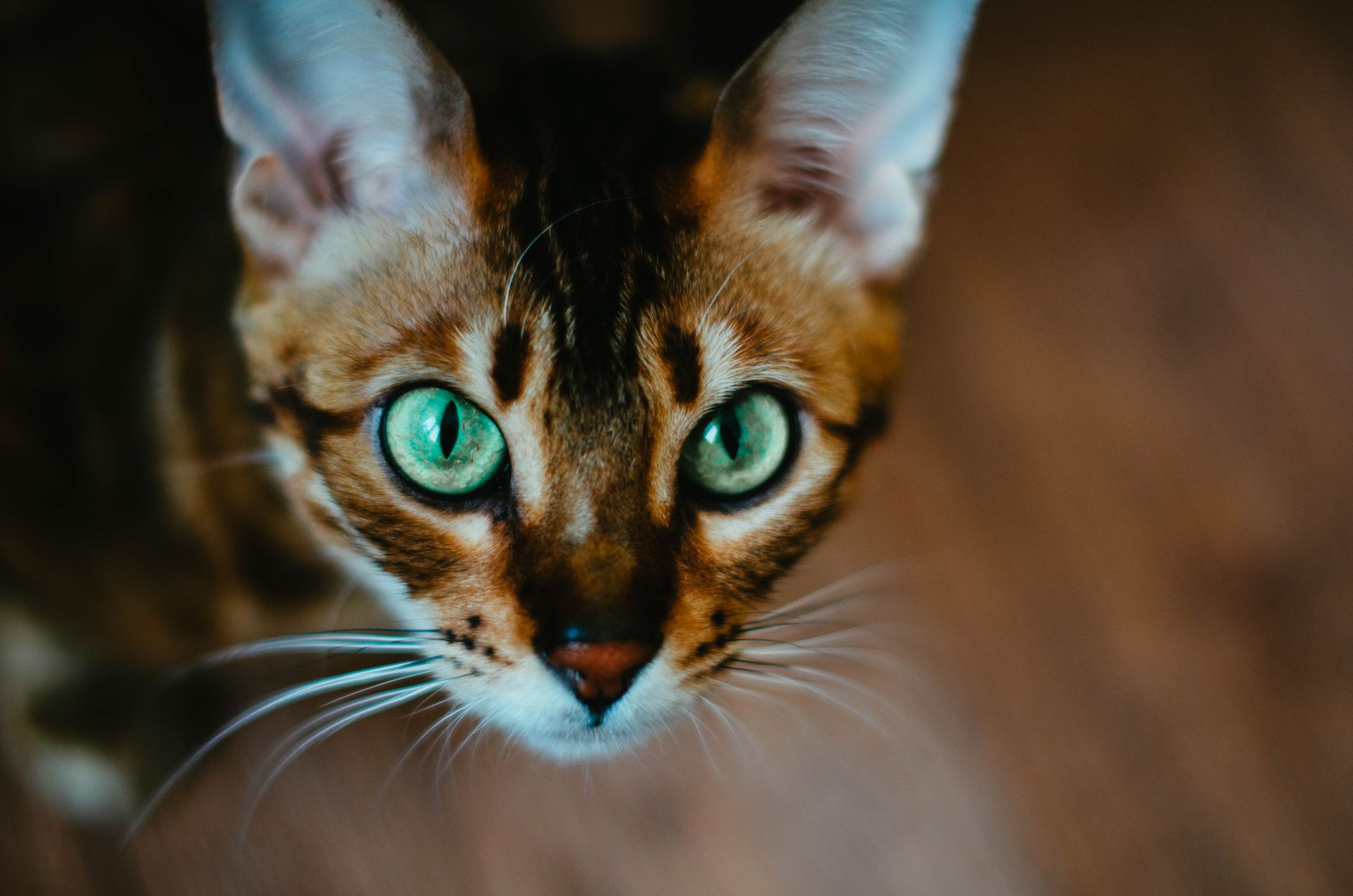
Green-eyed cats are relatively uncommon compared to cats with amber, yellow, or copper eyes, and this striking color is not exclusive to any single breed. However, certain breeds carry genetics that make green eyes far more likely. A green-eyed cat can appear in many breeds—including domestic shorthairs—but the color is most consistently found in Russian Blues, Egyptian Maus, Abyssinians, and some Oriental breeds. When you see a cat with truly green eyes (not yellow-green or blue-green, but a distinct emerald or jade shade), the cat typically has specific genetics related to how melanin deposits in the iris.
The term “green-eyed cat breed” is somewhat misleading, because green eyes don’t define a breed—rather, green eyes are a trait that appears more predictably in certain breeds. The Russian Blue, for example, is almost always born with green eyes and retains that color throughout life. An Egyptian Mau may develop green eyes within the first weeks of life. But a domestic shorthair can also have green eyes if it inherits the right genetic combination. Understanding which breeds are most likely to display green eyes, and why, helps cat owners know what to expect and how to care for a cat with this eye color.
Table of Contents
- Which Cat Breeds Most Commonly Display Green Eyes?
- The Genetics and Development of Green Eye Color
- When Do Kittens’ Eyes Turn Green?
- Eye Care for Green-Eyed Cats
- Health Issues Specific to Green Eyes
- Green Eyes and Feline Behavior
- Distinguishing Green from Amber, Yellow, and Other Eye Colors
Which Cat Breeds Most Commonly Display Green Eyes?
Several pedigreed breeds are strongly associated with green eyes. The Russian Blue is perhaps the most iconic: this breed almost always has green eyes, typically a vivid green that emerges as the kitten matures. The Egyptian Mau, another breed famous for its green eyes, displays an intense gooseberry-green color that is part of the breed standard. The Abyssinian, with its sleek ticked coat, frequently has green or amber-green eyes.
The Oriental shorthair and Oriental longhair also commonly inherit green eyes, as do some Siamese lines and Tonkinese cats. It’s important to note that not every individual of these breeds will have perfectly green eyes—some may have green-yellow or amber-green eyes instead—and green eye color is not required for breed registration in most major cat associations. A Russian Blue with amber eyes, for example, would still be registered as a Russian Blue. Conversely, a domestic shorthair can have strikingly green eyes and not be a purebred. The genetic pathway to green is simply more common in certain ancestry lines.
The Genetics and Development of Green Eye Color
Green eyes in cats result from a moderate amount of melanin in the iris—more than what produces blue eyes (which have almost no melanin) but less than what produces amber or copper eyes. The specific shade of green depends on how densely melanin is packed and how light scatters through the iris structure. Unlike human eye color, which is largely determined at birth, cat eye colors can shift during the first weeks and months of life. A kitten may be born with blue eyes (nearly all kittens are), and those eyes may gradually transition to green, yellow, or another color as melanin deposits accumulate.
One important limitation is that green eyes are not stable across the entire feline population. Environmental factors, age, and health can cause subtle shifts in eye tone. A cat’s eyes may appear more blue-green in dim light and more pure green in bright light due to how the iris reflects light. Additionally, some cats develop eye color that is difficult to categorize—a mix of green and yellow that breeders might call chartreuse or lime. If you’re purchasing a kitten specifically for green eyes, understand that the final eye color may not be known with absolute certainty until the cat is 8–12 weeks old.
When Do Kittens’ Eyes Turn Green?
Newborn kittens of most breeds are born with blue or slate-colored eyes because their irises contain very little melanin. As weeks pass, melanin begins to deposit in the iris, and the eyes gradually shift color. For breeds predisposed to green eyes, this transition often becomes visible by 4–6 weeks of age. A Russian Blue kitten might show hints of green by 5 weeks, with a fully green eye by 8–10 weeks.
An Egyptian Mau kitten may take slightly longer, with the characteristic green emerging by 10–14 weeks. The transition is gradual rather than sudden. You might observe a kitten’s eyes shifting from blue to blue-green, then to green over the course of several weeks. This process is entirely normal and requires no intervention. However, if a kitten’s eyes remain cloudy or blue-grey past 12 weeks, or if they appear asymmetrical (one green, one a different color), consult a veterinarian to rule out any vision problems.
Eye Care for Green-Eyed Cats
Cats with green eyes require the same basic eye care as any other cat: regular observation for discharge, cloudiness, or redness, and protection from trauma and irritants. There is no special maintenance specific to green eye color itself. However, you should monitor for any changes in eye appearance over your cat’s lifetime. Occasionally, an older cat’s eye color may fade or shift slightly due to age-related changes in the iris, and this is normal unless accompanied by vision problems.
One practical consideration is that cats with lighter eye colors, including green, may be more sensitive to bright light than cats with dark amber or copper eyes. If your green-eyed cat seems to squint excessively in bright sunlight or prefers dimly lit areas, you’re not imagining it—the lighter iris provides less natural protection. Providing shaded resting spots and gradual light exposure can make your green-eyed cat more comfortable during the day. This sensitivity is not a medical problem, merely a tradeoff of the eye color genetics.
Health Issues Specific to Green Eyes
While green eye color itself is not linked to any specific disease, certain conditions can affect cats with any eye color, including those with green eyes. Cats are susceptible to corneal abrasions, conjunctivitis, and uveitis (inflammation inside the eye). Some breeds prone to green eyes, such as the Abyssinian, have a higher incidence of progressive retinal atrophy (PRA), a degenerative eye condition. This is not caused by the green color but by genetics within the breed.
A critical warning: if your green-eyed cat develops redness, discharge, excessive tearing, or apparent pain in the eyes, seek veterinary care promptly. Do not assume that color changes in the eye (such as a shift toward yellow or cloudiness) are normal aging. While some color shift is expected, significant changes can indicate disease. Regular eye exams as part of your cat’s annual veterinary visits are the best way to catch problems early, particularly for breeds with known eye disease susceptibility.
Green Eyes and Feline Behavior
Some cat owners report that their green-eyed cats seem more alert or intense than their yellow-eyed peers, but this is anecdotal and not scientifically supported. Eye color has no bearing on a cat’s personality, intelligence, or behavior. The stereotype of the “mystical green-eyed cat” is romantic but unfounded.
Behavior is shaped by breed temperament, early socialization, individual personality, and environment—not eye color. That said, green-eyed cats may simply appear more striking to humans, leading owners to attribute personality traits based on appearance. A confident Russian Blue with vivid green eyes makes a memorable impression, and owners might attribute that impression to the eyes themselves rather than the cat’s actual behavior.
Distinguishing Green from Amber, Yellow, and Other Eye Colors
Green eyes are often confused with yellow, amber, or chartreuse because the line between them is not always clear. True green eyes have a distinct cool tone—a jade or emerald quality—whereas amber and yellow eyes have a warm, golden tone. The difference is most apparent in direct natural light. An amber-eyed cat photographed in indoor lighting might superficially resemble a green-eyed cat, but in daylight, the warm undertones of amber become obvious.
Blue eyes are the easiest to distinguish: they appear pale and lack the depth of green eyes. A kitten’s bright blue eyes are unmistakable. Copper eyes, the darkest feline eye color, are warm and very different from cool-toned green. If you’re uncertain whether a cat’s eyes are green or yellow-green, photograph the cat in bright natural light and compare the result to images of established green-eyed breeds like the Russian Blue or Egyptian Mau. The comparison will usually make the distinction clear.
- —