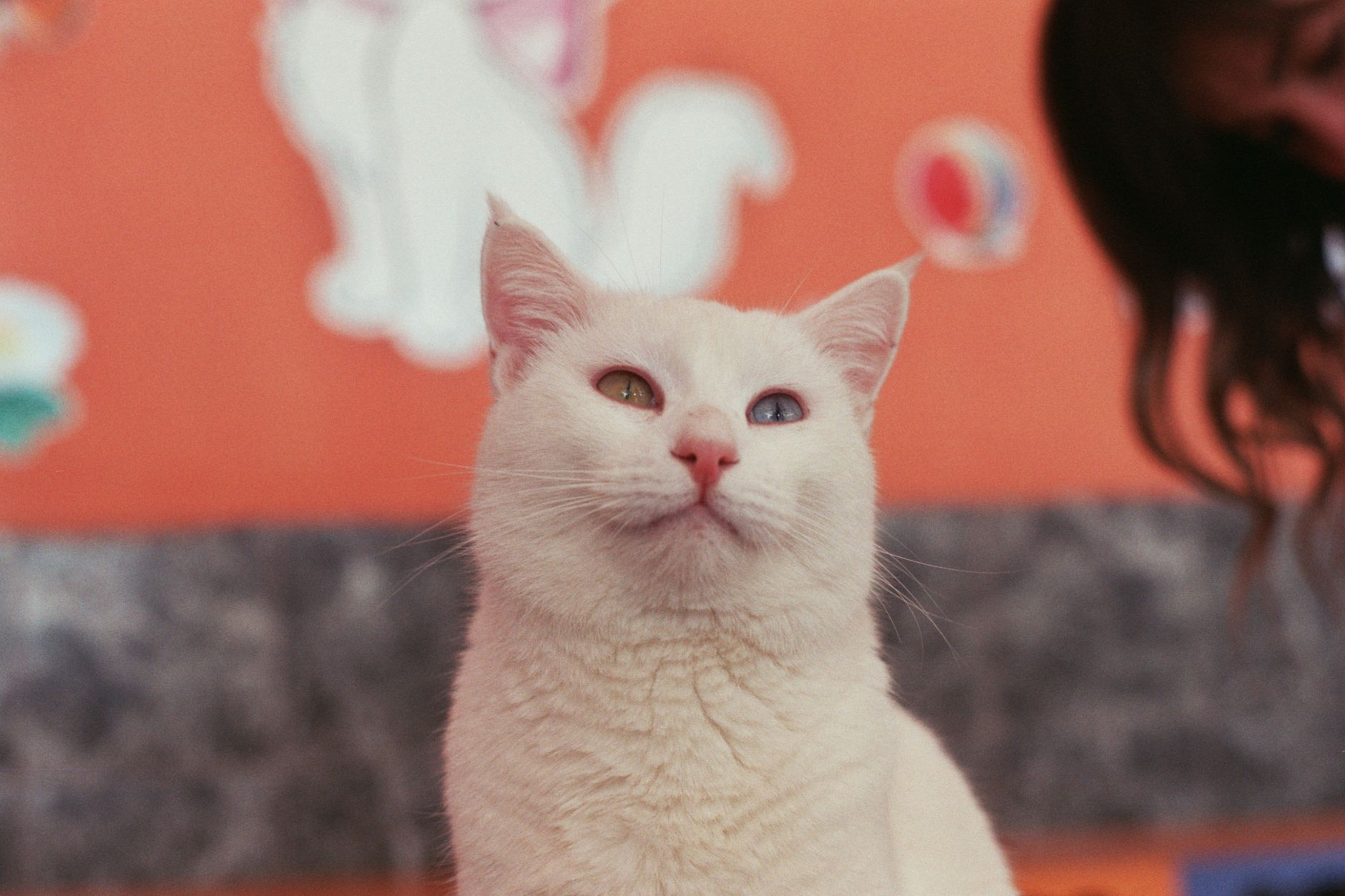
An odd-eyed cat has two eyes of distinctly different colors—one might be amber while the other is blue, or one green and one copper. This condition, called heterochromia iridis, occurs when a cat’s eyes contain different amounts of melanin pigment. A striking example is a white Turkish Van or Japanese Bobtail with one blue eye and one golden eye, a combination common enough in these breeds that many breeders actively select for the trait.
The condition is purely a pigmentation difference and does not affect how the eye functions, though it often travels alongside a specific genetic factor that can impact hearing in one or both ears. Heterochromia is neither a disease nor a disorder in most cats—it’s a visible result of how pigment distributed during development. Cat owners sometimes worry that odd-colored eyes indicate vision problems or pain, but the eyes themselves work normally. The actual concern is not the colors themselves but an unrelated genetic link that can cause deafness, particularly in white cats with blue eyes.
Table of Contents
- What Causes Odd Eye Color in Cats?
- Which Cat Breeds Display Odd Eyes Most Frequently
- Health Implications of Heterochromia in Cats
- How to Care for Odd-Eyed Cats
- Vision and Sight in Odd-Eyed Cats
- Identifying True Heterochromia vs. Other Eye Conditions
- Prevalence and Rarity of Odd Eyes in Cat Populations
- Frequently Asked Questions
What Causes Odd Eye Color in Cats?
Heterochromia develops when the two eyes produce different amounts of melanin during fetal development. A kitten’s eyes are usually blue at birth, and over weeks to months, melanin deposits into the iris, changing the eye color to the adult shade. If melanin concentrates unevenly between the two eyes, you get heterochromia. The genetics are not simple dominant-recessive inheritance; instead, the trait appears to involve multiple genes that regulate melanin production and distribution, which is why it cannot be predicted with certainty even when both parents carry genes associated with the condition. The mechanism differs from how heterochromia works in humans, where it often results from injury, inflammation, or inheriting two different pigment genes.
In cats, heterochromia most reliably occurs as a byproduct of the white coat gene (W), which suppresses melanin throughout the body. Cats carrying the white gene may develop heterochromia spontaneously, and breeders in certain breeds have noticed the pattern strongly enough to selectively breed for it. However, heterochromia can also appear in non-white cats and in cats without the white gene, which suggests additional genetic pathways exist. One limitation to understand: you cannot reliably predict heterochromia by looking at a kitten’s parents or known genetic markers. Even careful breeders aiming to produce odd-eyed kittens see the trait appear inconsistently across litters.
Which Cat Breeds Display Odd Eyes Most Frequently
Turkish Vans, Turkish Angoras, Japanese Bobtails, and Cornish Rex cats show heterochromia far more often than random-bred populations. The white Turkish Van is nearly synonymous with odd eyes in breed culture—many breed standards now describe blue and amber eyes as a desirable trait, and some breed clubs actively cultivate lines for this appearance. Japanese Bobtails also frequently show heterochromia, often with a white or tri-color coat pattern. These breeds have long selection histories that favor white coats, which correlates with both heterochromia and, importantly, the white-gene deafness risk. Siamese and other pointed breeds rarely show heterochromia because their genetics for coat color and eye pigment differ fundamentally from white-coated lines.
Solid-colored breeds show it infrequently unless they carry hidden white-coat genes. A significant warning: breeders pursuing heterochromia through selective breeding are simultaneously increasing the likelihood of white-gene-associated deafness. A white or mostly-white cat with blue eyes (whether heterochromic or not) has roughly a 60-80% chance of being deaf or having unilateral deafness. Breeders who select for the aesthetic of odd eyes without genetic testing for hearing capacity risk producing deaf cats with nowhere to go—shelters are already full of unadoptable deaf animals. Responsible breeders in these lines now perform early hearing tests (BAER tests) on kittens before placement, but not all do.
Health Implications of Heterochromia in Cats
The odd eyes themselves are healthy. The cat’s vision, depth perception, and eye function are unaffected by having different colored irises. However, heterochromia often appears alongside the white coat gene, and that gene carries a serious downside: deafness. Studies of white cats show that those with blue eyes have a 60-80% probability of being deaf in one or both ears. The gene that suppresses pigment in the coat (white) also affects neural development in the inner ear during fetal development, leading to degeneration of sound-sensing cells. The connection is directional but not absolute: not every white cat with heterochromia is deaf, and not every deaf white cat is heterochromic.
But the overlap is high enough that any white cat with blue eyes (the most common heterochromic pattern in white cats) should have a BAER hearing test performed before adoption or breeding. A BAER test measures electrical activity in the auditory nerve and can detect deafness at any age, even in very young kittens. Deaf cats can live full, happy lives in indoor homes where owners are aware of their condition. They startle more easily, cannot hear warning sounds, and need visual signals instead of voice commands. But they are not in pain, and heterochromia does not cause or worsen any hearing loss—the white gene does. This distinction matters because it prevents owner guilt (“I caused this by wanting pretty eyes”) and focuses the real responsibility on breeders and adopters to test and adapt.
How to Care for Odd-Eyed Cats
There are no special care requirements for the eyes themselves. Odd-eyed cats do not need different nutrition, different lighting, or different grooming routines than any other cat. You clean and check their eyes for discharge or irritation the same way—gently wiping away any crusting, watching for redness or excessive tearing, and seeing a vet if irritation persists. The real adaptation comes only if the cat is also deaf, which is a separate condition tied to the white gene, not the eye color.
If your odd-eyed cat has been tested and confirmed deaf, you’ll want to: keep them indoors always (no outdoor roaming where they cannot hear traffic or predators), use visual signals like hand gestures for commands, install motion-activated lights or vibrating alerts for door approaches, and inform visitors that the cat cannot hear. Some deaf cats adapt to vibrations or to watching their owner’s face intently for cues, which shows how well they compensate. An important comparison: caring for a deaf cat is less demanding than caring for a blind cat. A blind cat struggles with everyday spatial navigation, but a deaf cat navigates normally and only misses auditory information. Many owners report that deafness is the easier disability to manage.
Vision and Sight in Odd-Eyed Cats
The two different eye colors do not confer different vision qualities. Both eyes focus, both have normal tear production, both track movement, and both integrate into the cat’s binocular vision and depth perception. A cat with one blue eye and one amber eye sees depth and distance the same as a cat with matching eyes. The color difference is aesthetic only—it does not alter the mechanics of sight.
That said, a limitation worth noting: certain eye conditions, including some forms of glaucoma or uveitis (inner eye inflammation), can be harder to notice in odd-eyed cats if the colored iris masks gradual changes in pupil size or shine. A blue eye and an amber eye will naturally look different in how light reflects off them, so an owner might overlook subtle abnormalities like a dilated pupil or cloudiness. This is not a problem with heterochromia itself but rather a reminder to examine both eyes regularly and note their baseline appearance, so you notice if something shifts. Cats with white coats sometimes develop a higher incidence of sun sensitivity and squamous cell carcinoma (skin cancer) on their eyelids and nose. This is the white coat expressing itself, not the heterochromia, but odd-eyed white cats are at higher risk and benefit from shaded outdoor time or UV-protective screening on windows.
Identifying True Heterochromia vs. Other Eye Conditions
True heterochromia is straightforward to spot: the entire iris of one eye is a different color from the entire iris of the other eye. One eye is fully blue, the other fully amber. This is the most common presentation and requires no diagnosis beyond visual observation. Less common is sectoral heterochromia, where one eye has two colors within the same iris—perhaps a blue sector and an amber sector in the same eye. This can be striking and is sometimes confused with a cat having an injury or infection.
Sectoral heterochromia is still just pigment distribution and requires no treatment. However, if you see a sudden color change in one eye in an adult cat, or if the iris suddenly develops a new pattern, contact a vet—that can indicate uveitis or other inflammation. Cats with central heterochromia have a ring of one color around the pupil and a different color toward the outer iris edge. This pattern is common in many cats and is not usually considered true heterochromia (by genetics or breeding standards) because both eyes may be similar in their ring-and-outer pattern. Central heterochromia is the normal baseline in many breeds and is not associated with the white-gene deafness risk the way true whole-eye heterochromia (especially in white cats) can be.
Prevalence and Rarity of Odd Eyes in Cat Populations
In random-bred domestic cats, true heterochromia is relatively rare, occurring in roughly 0.5-2% of the population. The rarity is partly because the white coat gene is not uniformly distributed—only a fraction of cats carry it—and heterochromia is most common in those that do. In breed populations that select for white coats and odd eyes, the rate is much higher; some Turkish Van litters show heterochromia in 20-40% of kittens, depending on the breeding lines.
Statistically, odd-eyed cats are overrepresented in cat show catalogs and social media, which creates a perception that they are far more common than they actually are. Most indoor cats have matching eye colors. When odd-eyed cats appear in rescues and shelters, they are adopted quickly, which both reflects their visual appeal and can mask the fact that if they are white and deaf, they have landed in a rescue at higher rates because adopters struggle with managing deafness. Rescue data is not centrally collected, but informal surveys of shelter workers suggest that white odd-eyed deaf cats are overrepresented in intake relative to the general cat population.
Frequently Asked Questions
Is heterochromia painful for cats?
No. The different eye colors are purely pigmentation and cause no pain, discomfort, or vision problems. The cat sees and feels normally.
Can a kitten with heterochromia have kittens with heterochromia?
Possibly, but it is not predictable. Heterochromia results from complex genetic factors, not a simple inherited trait. Even if both parents have odd eyes, their offspring may not.
Are all odd-eyed cats deaf?
No. Deafness is linked to the white coat gene, not to heterochromia itself. A white cat with odd eyes has a higher risk of deafness, but not all white odd-eyed cats are deaf, and not all deaf cats are odd-eyed. Testing with a BAER test is the only way to know.
Does heterochromia affect a cat’s hunting ability?
No. Vision, depth perception, and prey tracking are unaffected. Odd-eyed cats hunt as effectively as any other cat.
Can heterochromia develop after a cat is born?
Rare after adulthood, but yes in kittens. Eye color continues to change and deepen as melanin deposits over the first weeks and months of life. A kitten’s eye color can shift and diverge between eyes during this period. Adult eye color is usually stable by 3-4 months of age.
Should I test my white odd-eyed cat for deafness?
Yes. A BAER (Brainstem Auditory Evoked Response) test is the gold standard and can be performed on kittens as young as 5-6 weeks. It is non-invasive and takes 30 minutes. Many veterinary schools and some general practices offer it. If the cat is deaf, you can adapt the environment and care accordingly; if the cat hears, that concern is resolved.